



Two of the world’s largest economies, namely Saudi Arabia and China, signed an agreement that “excludes” the dollar from their transactions.
The People’s Bank of China and the Central Bank of Saudi Arabia recently signed a local currency swap agreement worth 50 billion yuan ($6.93 billion), or 26 billion Saudi riyals, both banks said on Monday (November 20th), as bilateral relations are still being strengthened.
Saudi Arabia, the world’s top oil exporter, and China, the world’s biggest energy consumer, have been planning to develop their trade relationship beyond the energy market in recent years, expanding their cooperation in areas such as security and technology.
The swap agreement, which will be valid for three years and can be extended by mutual agreement, “will help strengthen economic cooperation … expand the use of local currencies … and promote trade and investment” between the Riyadh and Beijing, China’s central bank said in a statement.
China imported $65 billion worth of Saudi crude in 2022, according to Chinese customs data, accounting for about 83 percent of the kingdom’s total exports to the Asian giant.
Russia remained China’s top oil supplier in October despite higher Russian crude prices, with Saudi Arabia’s imports falling 2.5 percent from the previous month as it continued to tighten supply.

The swap agreements
Chinese President Xi Jinping told Gulf Arab leaders last December that China would work to buy oil and gas in yuan, but has yet to use its currency for oil purchases from Saudi Arabia.
Beijing has the largest network of currency swap agreements in the world, with at least 40 countries, but rarely discloses the broader terms of its agreements.
“China seems to be using swap lines in a very different way than the US,” said Weitseng Chen, an associate professor at the National University of Singapore.
“(China) uses it as a line of credit, so it’s on an ongoing basis, rather than a one-off like during a financial crisis.”
Argentina in October activated a $6.5 billion currency swap line with China for the second time in three years to boost the growth of its depleted foreign reserves amid a deep economic crisis, with annual inflation above 130% and while foreign exchange reserves in dollars in its central bank reach negative levels.

BRICS: Trade up +56%
Trade between the five nations of the BRICS group has grown by 56 percent over the past five years, reaching a total of $422 billion, according to data released by the Bank for International Settlements.
The five existing BRICS members Brazil, Russia, India, China and South Africa signed international trade deals worth $422 billion between 2017 and 2022.
The BRICS countries remain important trading partners as they are rich in natural resources and agricultural products, except for Russia.
However, Russia, on the other hand, complements the alliance by exporting crude oil to other developing countries. Trade growth between 2017 and 2022 remains normal. However, things change in 2023 as the BRICS alliance seeks to end dependence on the dollar.
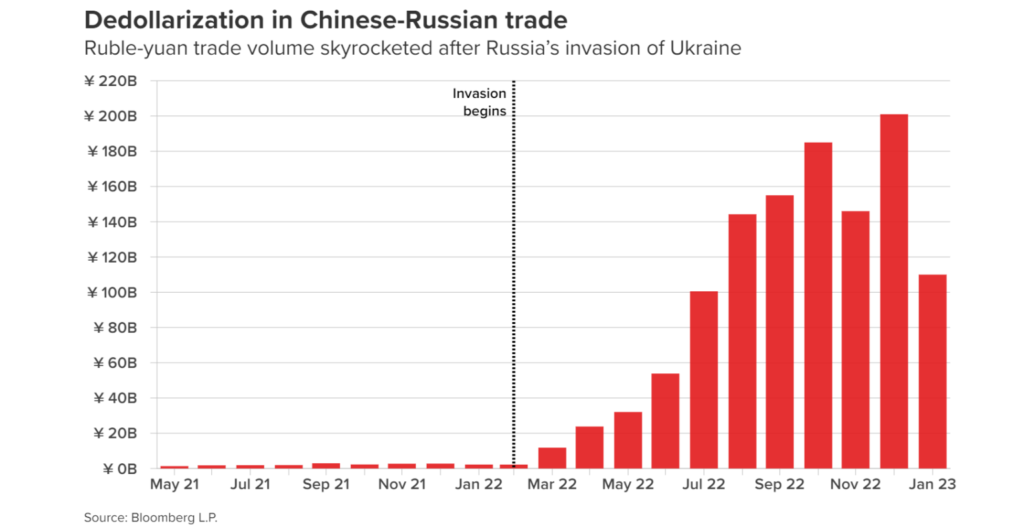
As demand for trade among BRICS countries increases, the chances of the alliance transacting in local currencies rather than the dollar remain high. The development puts the outlook for the dollar at risk as the BRICS may start all trading in local currencies.
Cross-border transactions in their respective local currencies worth $400 billion could add pressure to the US economy. Read here to find out how many sectors in the US will be affected if the BRICS stop using the dollar for trade.
The development could “suffocate” the US dollar and reduce the currency’s supply and demand dynamics in international markets.
If demand for the dollar falls, the move could push the US economy into huge budget deficits. Such a situation could send prices skyrocketing in the US and the potential for hyperinflation to remain high.
If the BRICS announce that they will use local currencies for transactions in 2024, the dominance of the US dollar will gradually diminish.
