



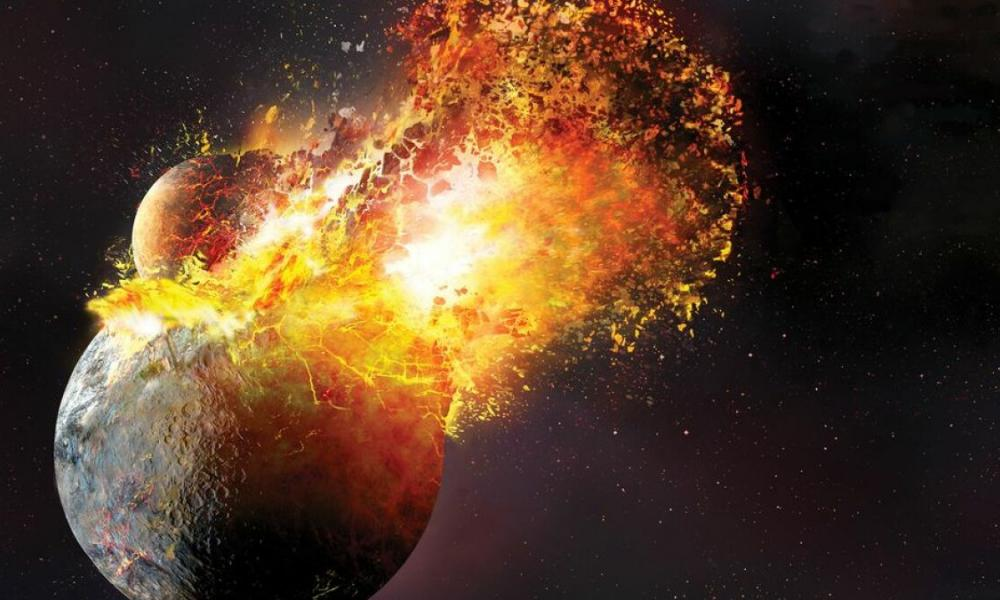
The international scientific community more or less agrees that an ancient planet likely crashed into Earth as it was forming billions of years ago, spewing debris that coalesced into the Moon.
The prevailing theory of the “giant impact hypothesis,” as it is called, explains many fundamental features of the Moon and Earth. But the question is what happened to the planet Theia, as no tangible evidence of its existence, such as remnants in the solar system, has been found until now.
Many scientists have speculated that any debris Theia left behind on Earth melted in our planet’s inner fiery cauldron and formed the Moon. Now, a new theory suggests that the remains of the ancient planet remain partially intact, buried beneath our feet. Theia’s molten slabs likely became embedded in Earth’s mantle after the impact before solidifying, according to a study published Wednesday November 1, in the journal Nature titled “Moon-forming impactor as a source of Earth’s basal mantle anomalies“.
The mysterious rock formations beneath the surface of the Earth
Two huge rock formations about 2,900 km below the Earth’s surface have been puzzling geologists since the 1980s when seismic waves revealed their existence.
These continent-sized formations lie at the bottom of Earth’s rocky mantle near its molten core, one under Africa and the other under the Pacific Ocean. Scientists have found that these formations are much hotter and denser than the surrounding rocks.
And the new research suggests that these are “buried remnants” of Theia, which entered Earth during their collision and have been hiding near the heart of our planet ever since. In addition to creating the Moon, this collision and the debris it left behind may have helped Earth become the only planet to host life, say the researchers, who reported their initial findings in 2021 at a scientific meeting.
Huge impact from the findings
Qian Yuan, a geodynamics researcher at the California Institute of Technology (CalTech) and lead author of the study, told AFP that it was “quite surprising” that no evidence of Theia’s impact with Earth had been found.
Yuan began to piece together the puzzle when during a planetary scientist’s class, he heard him say, “Where is the celestial body that collided with Earth? My answer is: it’s on Earth,” he said. It should be noted that the scientist in question had never heard of the rock formations under the surface of our planet.
Since then, the research has required experts from the separate fields of space exploration and geology to join forces. Yuan said that when Theia crashed into proto-Earth, it was traveling at more than ten kilometers per second, a speed that allowed some of its debris to penetrate “very deep into the Earth’s lower mantle.” A video developed by the team that simulates this process shows how clumps of Theia’s mantle tens of kilometers wide swirled into the Earth.
As Theia’s mostly molten material cooled and solidified, its high iron content caused it to sink into the boundaries of Earth’s mantle and core, the scientists said. Over the years, it accumulated into two separate masses, which are now each larger than the Moon, Yuan said.
How Earth changed after the collision with Theia
Earth is the only known planet in the universe that harbors life. The collision with Theia, believed to be Earth’s last major accretion event, changed the composition of our planet in just 24 hours, Yuan said.
“My feeling is that this initial state is why Earth is unique, because it’s different from other rocky planets,” he noted.
Previous research has suggested that Theia may have brought the basic ingredient of life, water, to Earth.
The mysterious rock formations have been observed sending ‘mantle jets’ – columns of magma – towards the Earth’s surface, and have also been linked to the evolution of supercontinents. Theia “left something on Earth, and that played a role in the next 4.5 billion years of its evolution,” Yuan said.
