


The Russian Empire, the largest state in the world at that time, stretched from the Vistula and Pruth to distant Sakhalin and Port Arthur on the Korean peninsula. But opposite the seemingly mighty empire of the Tsars, there was an emerging new and even non-European power, the empire of the Rising Sun, Japan.
Russia and Japan had early visions of the stillborn corpse of imperial China, whose province included the mineral-rich Manchuria. In 1894, Japan was involved in a war with China, which it defeated state by state. With the peace treaty, the Chinese ceded Formosa (present-day Taiwan) and the Port Arthur peninsula to the victors.
The Russian Empire, the largest state in the world at that time, stretched from the Vistula and Pruth to distant Sakhalin and Port Arthur on the Korean peninsula. But opposite the seemingly mighty empire of the Tsars, there was an emerging new and even non-European power, the empire of the Rising Sun, Japan.
Russia and Japan had early visions of the stillborn corpse of imperial China, whose province included the mineral-rich Manchuria. In 1894, Japan was involved in a war with China, which it defeated state by state. With the peace treaty, the Chinese ceded Formosa (present-day Taiwan) and the Port Arthur peninsula to the victors.
However, the Russians also had visions in the region, who, by ensuring the cooperation of the French and Germans against the “Asians”, pressured the Japanese and forced them to give up their possession of Port Arthur, which remained Chinese, albeit for a while.
In 1897, a Russian fleet arrived at Port Arthur and after negotiations China “agreed” to cede, conditionally, the wider area to Russia. The Russians immediately began to fortify the excellent natural harbor and build railways connecting Port Arthur with Harbin and Mukden in Manchuria.
At the same time it was decided to extend the famous trans-Siberian railway to Port Arthur. It was clear that the Russians intended to extend their dominance in the region, an area that Japan had considered its own sphere of influence since the Middle Ages.
The attempt to expand the Russian railway network was one of the causes that caused, in 1900, the Boxer Rebellion in China, which was put down in blood by an inter-allied force, with the participation of Russians and Japanese. Russia, after suppressing the rebellion, continued to expand dangerously for Japanese interests in Korea and Manchuria.
The Japanese attempted to react through diplomatic channels, but all their attempts were met with brutality by the Russians, who clearly treated them as subhuman.
On July 28, 1903, the Japanese ambassador in St. Petersburg formally submitted his country’s proposals, under which Japan fully recognized Russian control over Manchuria, asking in return for Russian recognition of a zone of Japanese control in North Korea.
The Japanese waited until February 1904 for the Russian response, but it never came. In response, the Japanese ambassador left St. Petersburg on February 6. Japan-Russia relations were subsequently irreparably shaken. The Russians were now openly talking of war. It didn’t take long for the Japanese to come to the conclusion that weapons would be the solution.
Admiral Togo
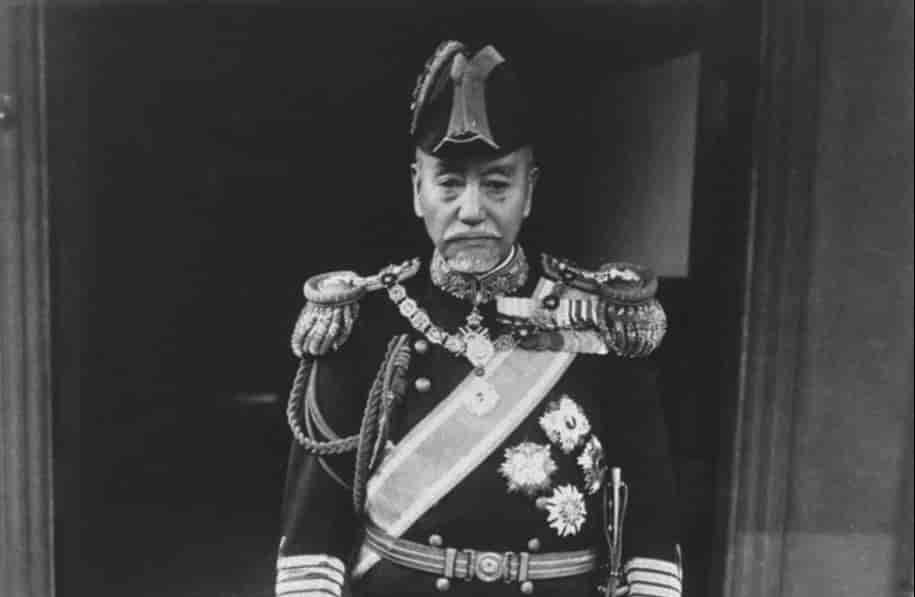
The Japanese decided to strike first, aiming to destroy the Russian Far East Fleet, which was anchored in Port Arthur and Chemulpo (present-day Incheon, Korea). The Japanese fleet commander, Admiral Heihashiro Togo, at the age of 20, had participated in his first naval battle with the Imperial Japanese Navy against the rebellious followers of the last Shogun.
He continued to fight until 1869, when the penultimate Japanese civil war ended and imperial power was established. Togo distinguished himself in all these conflicts and was sent to Britain for training between the years 1871-78. When the Franco-Chinese War (1884-85) broke out, Togo closely followed the action of the French fleet under Grand Admiral Courbet.
When the First Sino-Japanese War broke out, Togo, commander of the cruiser Naniwa, did not hesitate to sink a British freighter, carrying Chinese troops, chartered by the Chinese. His action almost caused a serious diplomatic incident between Japan and Britain, but it also demonstrated the determination of the Japanese officer and his obsession with achieving his goal, regardless of the means he had to use.
He would show the same determination ten years later, as commander of the Imperial Japanese Navy, against the Russians.
The undeclared war
Togo, the “Nelson” of the East as he was called, was a man whose only consideration was victory. Like all Japanese at the time, he did not wish to engage in war against one of the world’s greatest powers, Russia. On the other hand, like all Japanese, he felt terribly offended by the attitude and immense arrogance of the Russians.
With Russian supremacy in mind he inspired – as did Yamamoto later – a “preemptive” strike against the Russian Far East Fleet, within its own anchorages. The Japanese Navy was quite strong at the time, having 6 newly built British-designed battleships, the Mikasa (flagship), Hatchuse, Yashima, Shikishima, Asahi and Fuji, two squadrons of modern cruisers (9 vessels), 15 destroyers, about 20 torpedo boats and 5 submarines.
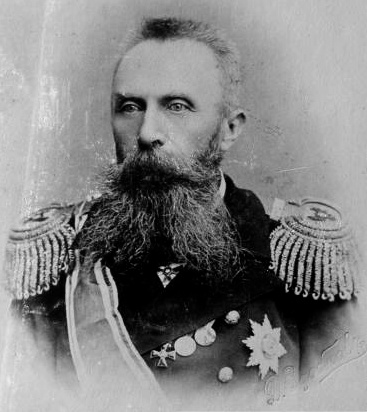
The Russian naval forces in the region, under Vice-Admiral Oscar Viktorovich Stark, a good seaman and noted explorer, were also strong. The Russians had six battleships, the modern and powerful Petropavlovsk, Poltava and Sevastopol, the smaller and less powerful Peresviet and Pompeda, the Tsarevich, one of the newest and most powerful ships of the Russian Navy, and the also newly built American-built Retvizan. They also had 5 cruisers and smaller auxiliary vessels.
Theoretically, the Russians with these ships could, if not decisively defeat the Japanese, at least cause them heavy losses. This was what Togo wanted to avoid.
Japan decided to declare war on Russia on February 10, 1904. But Togo was already at sea with all her forces, ready to strike the Russians where they least expected it, at Port Arthur. In the fortified harbor, on the evening of February 8-9, all the officers attended a reception given by Vice-Admiral Stark in honor of his wife.
Nevertheless, Russian destroyers patrolling outside the harbor detected the movements of Japanese torpedo boats, which Togo had ordered to launch surprise attacks on the Russian ships. The Russian commanders of the patrol boats did not know the intentions of the Japanese, however, and simply reported the fact to the administration, which, it seems from the facts, did not pay much attention to the fact.
At exactly 10:30 PM, the Japanese struck the Russian armada, albeit uncoordinated. In the confusion two of their ships collided with each other. Overall, between 10:30 p.m. to 2:00 a.m. on February 8-9, the Japanese attacked with 8 torpedo boats against the Russian ships, firing 16 torpedoes.
Only three of them found their target. But the targets that were hit were particularly important. They were the powerful battleships Tsarevich and Retvizan and the protected cruiser Palada. The next day, February 10, 1904, the tsar received the official declaration of war!
The naval battles of Port Arthur
The dawn of February 9 found Togo in agony. He was unable to know the success rate of his surprise attack. Around 8:00 am, he ordered Vice-Admiral Sigheto Deva, commanding the 4-boat 2nd Cruiser Squadron, to sail to Port Arthur and observe the movements of the Russians. Deva actually sailed to Port Arthur.
The Japanese cruisers approached within 7 km of the Russian anchorage without being detected. Deva saw “3-4 ships heavily battered and the rest of the fleet in confusion.” From what he saw, and from the fact that he came so close without being fired upon, he concluded that the Russian fleet had been destroyed! He immediately returned and made his optimistic report to Togo, urging him to sail with the whole fleet and finish off the Russians.
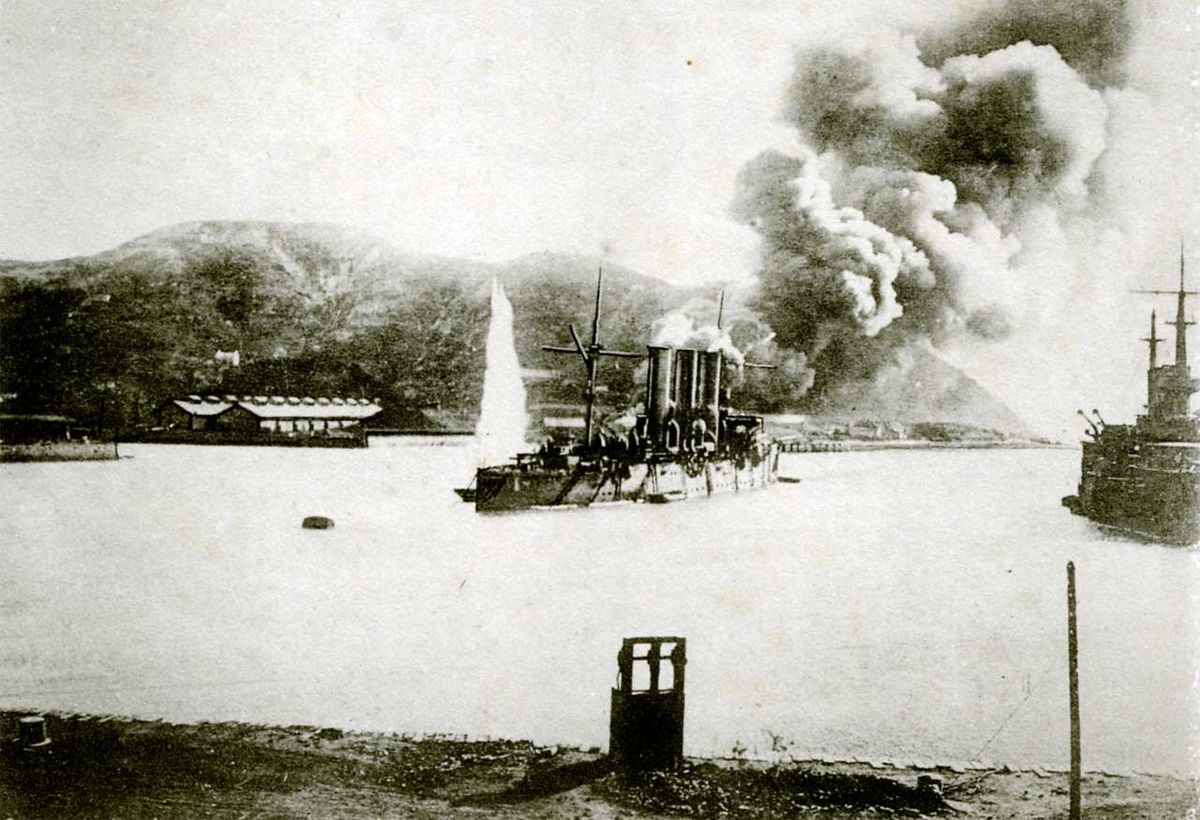
Togo actually headed for port, but cautiously, sailing with his squadron of battleships in the lead. But when he approached the harbor he saw with horror that the Russian fleet and, worse, the heavy coastal artillery were ready. The Russian light cruiser Boyarin, which was patrolling outside the port, launched a barrage with 120 mm guns, without effect. against the advancing Mikasa.
But then, soberly, he withdrew. However, the sea soon began to get rough. The Mikasa took a serious hit on the opposite bridge. Togo then ordered his battleships to open fire with their heavy 305mm guns. against shore guns and with their secondary guns against Russian ships. The Russians responded and the blows on both sides were severe.
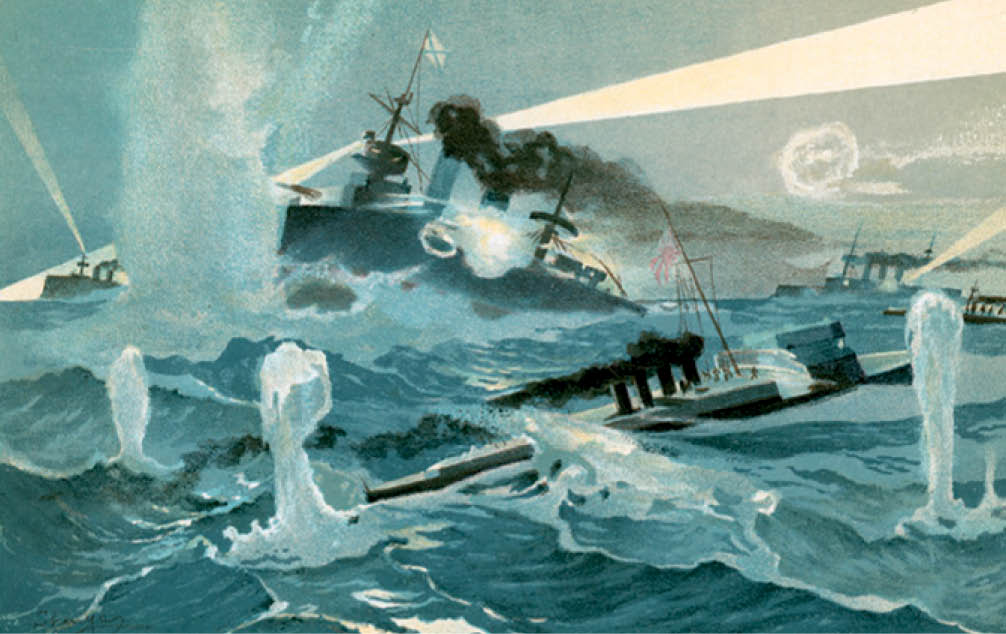
The Japanese hit the battleships Petropavlovsk and Poltava and the cruisers Novick, Diana and Askold. But the Russians also hit the Japanese battleships Fuji, Shikishima and Hatsuche as well as 5 cruisers. Togo, faced with this situation, decided to withdraw. But as the 2nd Cruiser Squadron headed south, the Russian light cruiser Novik, although already damaged, bravely attempted to hit the Japanese cruisers with a torpedo volley. But all 5 torpedoes he launched did not find a target.
Instead, the Japanese gunners hit it very hard from a distance of 3 km below the waterline. Nevertheless, it survived to later become a ship of the Japanese Navy.
However, the naval battle ended without a winner, with the Russians suffering 150 casualties and the Japanese 90. The next day the Russians decided to take security measures to avoid another Japanese surprise. For this the minelaying Yenisei began to mine the entrance to the port.
But the boat hit one of its mines and sank, taking 120 of its 200 men with it. But the most important thing was that the boat took to its wet grave the unique map of the minefield that it had planted! The Boyarin, sent to help, also hit a mine and was abandoned. She was left to drift unruly, until two days later she hit a second mine and sank.
After the naval battle, Togo had docked with her fleet at the Japanese base of Sasebo in Korea. There, after repairing his ships, he decided to sail again to Port Arthur with the intention of sinking 5 old cargo ships at the entrance of the harbor to trap the Russian ships inside. On February 24, the action was carried out, but it did not work, since at the entrance of the harbor it had run aground on the shoals of the wounded Retvizan.
The Russians meanwhile opened fire and in the low visibility conditions they believed their own fire had caused the sinking of 5 Japanese battleships! Overjoyed, the governor of Port Arthur, Admiral Yevgeny Alekseyev, hastened to inform the Tsar of the great victory by telegraph. Of course, when the truth was revealed, his shame was unprecedented.
On March 8, 1904, however, Russian morale skyrocketed, as perhaps the best Russian admiral, Stefan Makarov, took command of the Far East Fleet, replacing Vice-Admiral Stark. Two days later, Makarov attempted a first sortie with 6 destroyers. But two of them sank into conflict with the Japanese. On 22 March, Makarov launched another attack against the Japanese, forcing the battleship Fuji to withdraw for repairs.
A further Togolese attempt on 27 March to blockade the port of Port Arthur by sinking old stone-laden cargo ships at the entrance failed, the Russians catching up and sinking them before they could approach.
On 13 April, the Russian fleet, with Makarov hoisting his ensign on the battleship Petropavlovsk, sailed from port to engage the Japanese. Makarov had with him all six battleships – the two damaged ones had been repaired – three cruisers and some destroyers. But Togo had mined the area. At 9:30 AM, Petropavlovsk struck the first mine.
Two more explosions followed and at 9:43 a.m. the battleship tossed into the air along with its 635 men, among them Admiral Makarov.
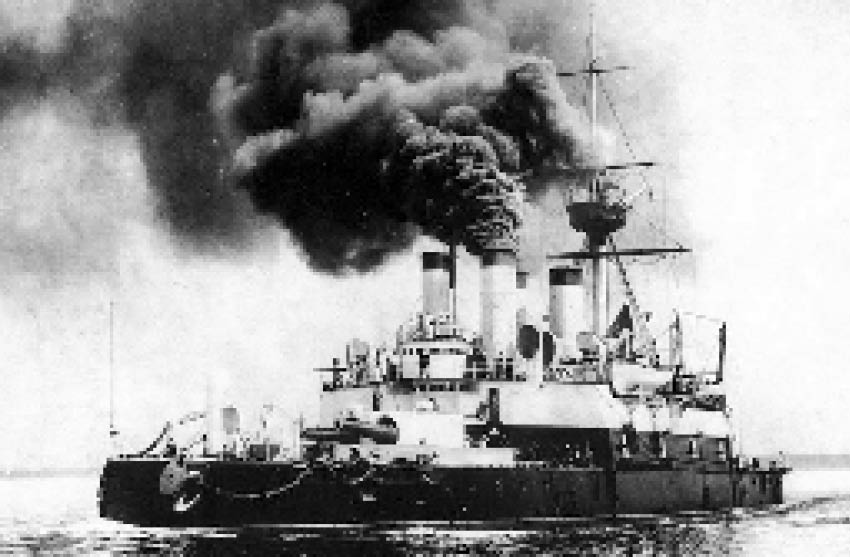
With his death the aggressive spirit completely disappeared from the Russians. The Pompeda had a similar fate, which nevertheless managed to stay afloat and somehow return to port.
Togo held Makarov in high esteem. So the next day he ordered all his ships to fly their flags at half-mast, mourning the loss of a worthy adversary, as the custom of the Samurai dictated.
On 3 May, Togo once again attempted to scuttle 8 old trucks at the harbor entrance, but again failed. But this was of little importance. Because, after the death of Makarov, the Russian fleet gave no signs of life.
However, on May 15, it was the Japanese’s turn to pay a heavy price for the relatively new naval weapon, the mine. The battleship Hatsuche struck two mines and sank with more than half of her crew (486 men). Moments later she hit two mines and the battleship Yashima, which sank along with 200 of her crew. The mines were laid by the Russian narcotics Amur. Thus, by a whim of fortune, the Japanese fleet lost 1/3 of its battleships in half an hour.
Nevertheless, the blockade continued. A lukewarm Russian attempt to break the cordon was repulsed on 23 June. A second and more important one, on August 10, led to the naval battle of the Yellow Sea.
The naval battle of the Yellow Sea
After Makarov’s death, Rear Admiral Wilhelm Wittgeft was placed in charge of the Russian squadron. He did not show much desire to clash with the Japanese, and probably not without reason, since his ships were also in bad shape and the morale of the crews was at its nadir. Soon, however, Vitgeft came into conflict with the governor of Port Arthur, Alekseyev, who, with Tsarist approval, was pressing Vitgeft to try the luck of the guns again. Having no other choice, Vitgeft decided to set off.
On August 10, 1904, the Russian fleet, consisting of the battleships Tsarevich, Retvizan, Pompeda, Peresviet, Sevastopol, and Poltava, 4 cruisers, the Askold, Diana, Novick, and Palada, and 14 destroyers, sailed from Port Arthur to engage with the Togolese fleet or at worst escape to Vladivostok. The Russian reasoning was that after the loss of the two Japanese battleships, their forces were vastly outnumbered by the Japanese. But this was only theoretical.
And this is because the Russian ships now had a reduced fighting value, since they needed repairs from the blows they had already received in the previous conflicts, while the morale of the crews was extremely low. On the other hand, the Japanese may have lost two battleships, but they had four armored cruisers, armed with 203 mm guns, that could stand up to the older Russian battleships.
Also three other Japanese protected cruisers had 203mm guns.
Togo believed that the Russians would also attempt a new exit and was ready. With the battleships Mikasa, Asahi, Fuji and Shikishima, 10 cruisers, 18 destroyers and 30 torpedo boats awaited the enemy. In the early afternoon of August 10, the Russians did leave the harbor.
Togo immediately sailed to the end of the Russian line with the aim of placing his fleet between the Russian and Port Arthur. With this move, despite the dangers from the coastal Russian guns, he ensured the inability of the Russian fleet to return to port. Vitgeft then changed course and turned south with the apparent aim of reaching Vladivostok. Togo was not prepared for such a move and was taken by surprise. But he quickly recovered and moved swiftly towards his prey.
At 5:43 p.m. the Mikasa opened fire first from a distance of 9,000 yards. Soon, the Russian battle line turned towards the enemy and returned fire. At first, the battle developed into a duel between the two flagships, Tsarevich and Mikasa. Around 6:00 p.m. the Tsarevich’s bridge was hit and Vitgeft fell dead.
A second blow crushed the bridge of the Russian battleship, killing or seriously wounding all officers. For some time the ship sailed unmanned, followed by the rest of the Russian battleships deployed in line. Suddenly, the Tsarevich made a 180 turn and found itself on a collision course with the battleship that was following it! Before long the whole Russian line of battle was in incredible confusion.
No governor knew what was going on. So most of the masters decided to return to Port Arthur. Finally, 5 battleships, 1 cruiser and 9 destroyers returned to the port. The Tsarevich with 3 destroyers fled to the German port of Chidago and was detained there. The Askold and a destroyer fled to Shanghai and were detained by the Chinese authorities. The Diana fled to Saigon and was also detained by the French colonial authorities, and only the Novick attempted to reach Vladivostok. But it was caught during a coaling by two Japanese cruisers and its captain preferred to sink it. Later, the Japanese raised it, repaired it and integrated it into their fleet.
The journey of the damned
The strategic defeat of the Russian fleet in the naval battle of the Yellow Sea resulted in the complete blockade of Port Arthur from the sea and the free transfer of forces from Japan to Korea. The Russian ships closed at Port Arthur were doomed to be ignominiously destroyed by the heavy artillery of the besieging Japanese army.
In Russia the news of the defeat caused indignation. In an unprecedented, heated decision, the Russian leadership decided to send almost the entire Baltic Fleet to lift the blockade of Port Arthur. Under Admiral Zinovi Rostestvensky, 5 squadrons of the Baltic Fleet, which was renamed the 2nd Pacific Squadron – a euphemism with no practical counterpoint – it was decided to sail from the Baltic, move parallel to the West African coast, enter the Indian Ocean and, having to cross 33,000 km, reach Port Arthur and fight the Japanese fleet.
Even for Tsarist Russia, the decision was rather excessive. Nevertheless, Rostestvensky had no other choice and on October 15, 1904, he set off on “the journey of the damned”, as it was originally called.
His fleet consisted of three squadrons of battleships (11 ships), the Knyaz Suvorov, Emperor Alexander III, Borodino, Orel Oslyabiya, Sisoi Veliki, Navarin, Emperor Nikolai I and the coastal defense battleships Admiral Apraksin, Admiral Senyavin, Admiral Usakov. Of these, however, only five carried 305 mm guns as their main armament. such as Japanese battleships.
The rest were of old construction, slow-moving and equipped with 254 mm guns. Also, the 1885-built old battleship Admiral Nakimov, which carried 203 mm guns, had joined the battle line of battleships. The fleet also had 7 cruisers – the two armored (the term of the time corresponding to the latest heavy cruisers) and one equipped merchant, 9 destroyers and 9 more auxiliary ships.
The journey began in an atmosphere of insecurity and fear. In the North Sea, Russian ships opened fire on British fishing boats, fearing they were Japanese torpedo boats! A serious diplomatic incident ensued and lengthy explanations were required to persuade the British to allow the voyage to continue. However, the British did not allow the Suez Canal to be used – as they had allowed Mussolini in 1935-36, for example – and so Russian ships were forced to sail around Africa.
After various unfortunate events and countless imagined opponents, the Russian ships arrived in French Indochina in May 1905, after a 7-month voyage. Of course, the morale of the crews was crushed and the fleet was just not ready for battle. In addition, the ships had suffered several damages during the voyage and their reefs needed cleaning.
Morale sank even further when on January 2 it became known that Port Arthur had surrendered. Vladivostok was now the only destination left. There were three possible routes for the Russian ships to reach there, the Straits of La Pérouze, Tsugaru and Tsushima. The latter was the shortest way.
The Tsushima Strait takes its name from the eponymous archipelago of small islands located between Korea and Japan, just south of the Korean peninsula, west of the Japanese metropolitan island of Kyoshu. Togo himself having perceived that the Russians would attempt to pass through the straits of Tsushima, decided to wait for them there.
The disaster
On the night of May 26-27, the Japanese auxiliary cruiser Shinano Maru spotted in the foggy night a faint light at the bottom of the horizon.
The vessel sailed towards the light and found itself in front of the Russian hospital ship Orel. The captain of the Russian vessel spotted the Japanese vessel but believed it to be Russian and so did not see fit to inform Admiral Rostestvensky.
The Japanese commander, Captain Narukawa, continued to sail between the Russian ships and made out 10 more silhouettes of ships in the night. At 4:55 am notified Togo. The Japanese admiral immediately sent the light cruisers to monitor the Russian movements in the area he had indicated on the Shinano Maru.
At first light on May 26, the battle began. At 6:43 am Togo sent the following message to Tokyo: “I have just been informed that the enemy fleet has been spotted. Our fleet will move against it, attack it and destroy it.”
At the same time, Togo deployed his ships in line of battle, with the Mikasa, Shikishima, Fuji and Asahi leading, the armored cruisers Kasuga and Nishin following, and 6 other cruisers following. The Russian fleet also sailed in line of battle but in two columns. In the starboard column sailed the battleships Suforov, Alexander III, Borodino and Orel, to their left the other two squadrons of battleships with two cruisers between them, with the remaining cruisers following.
The two fleets made visual contact around 1:40 p.m. Fifteen minutes later, Togo sent a signal to his ships saying, “The fate of our empire depends on the outcome of today’s conflict. Let every man do his duty.”
Togo, taking advantage of the superior speed of its line of battle, which reached 17 knots against the Russian’s 12, managed after maneuvering for about an hour to cross the T of the Russian fleet. In this way his whole fleet could use almost all of its heavy guns against the Russian ships, which could only respond with their bow guns. The Russians opened fire first from a distance of 7 km.
The Japanese responded when they got within 4 miles (6.5 km). The Japanese gunners began to lay down furious rapid volleys. The Russians could not answer, especially the gunners of the old ships, with the small guns.
The Russian ships carried coal and this was another disadvantage, since a successful firing of an explosive projectile would immediately cause a fire. Soon, the volume of fire of the 4 Japanese battleships was concentrated on the Russian flagship Suvorov, on which Rostestvensky was also aboard. The ship began to burn.
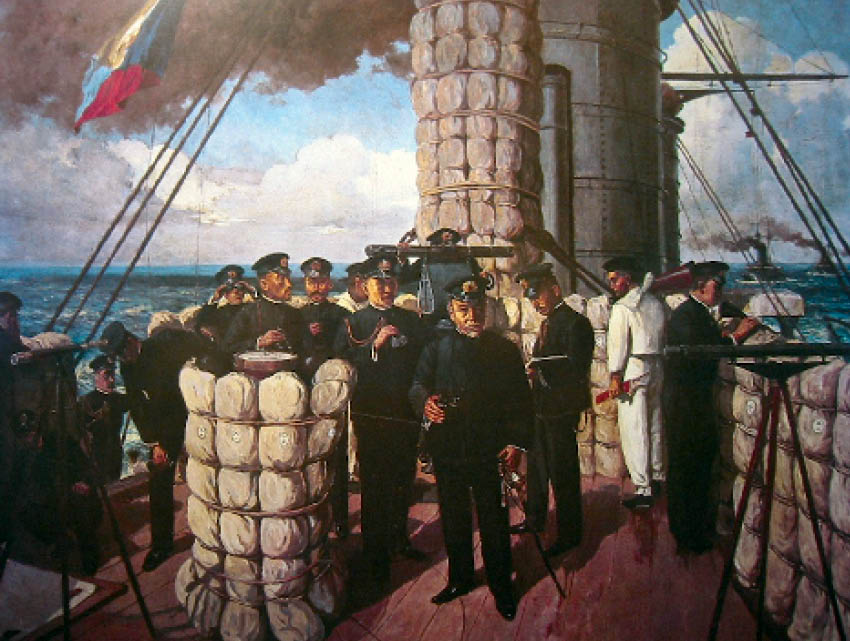
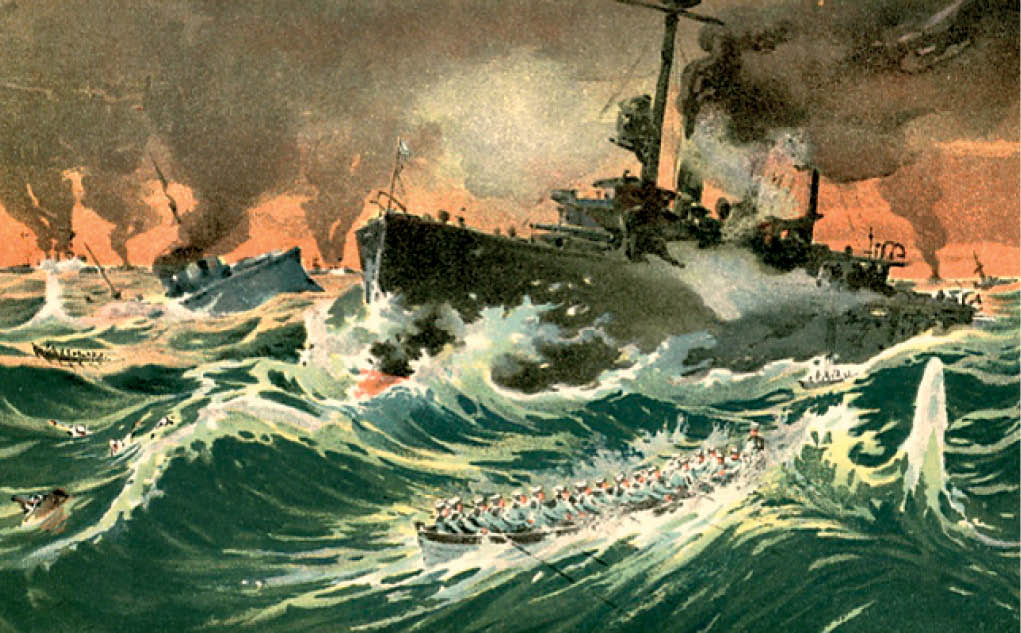
The Russian admiral was wounded. A destroyer picked him up. The Suvorov meanwhile, as well as the Oslyabia, at the head of the second column of the Russian fleet, had been reduced to burning floating coffins. Suvorov, however, refused to sink and continued to fight with her smaller guns until 7:20 pm, when torpedoes from Japanese torpedo boats sent her to the bottom along with 928 of her men.
The same fate had the Alexander III, which was torn to pieces by 305 mm hits. it leaned to the side, capsized and was lost in the sea. But Borodino also blew up, apparently when the ammunition depots were hit. The strongest Russian ships had already been destroyed.
It was a massacre. “It is impossible to count the missiles that hit us. The missiles come at us one after the other. Armour, superstructures, bridges are being torn to pieces and their pieces are causing heavy casualties… Guns have been dislodged from their positions.
The temperature is too high. Flames from the explosions spread everywhere. I saw that the armor plates had been set on fire,” Suvorov survivor Admiral Vladimir Semyonov reported in horror.
The night that fell did not save the Russian fleet. The Japanese destroyers and torpedo boats launched continuous torpedo attacks, which caused the sinking of the battleship Navarin and, most importantly, caused utter panic among the surviving Russians. The Sisoi Veliki was also hit by a torpedo, which sank the next morning.
The next day, the remnants of the Russian fleet were in dire straits. Rostestvensky’s replacement, Admiral Nebogatov, saw no other solution but surrender, refusing to needlessly sacrifice the lives of the remaining men. “You are young and you are the ones who will restore the honor of the Russian Navy,” he told his men.
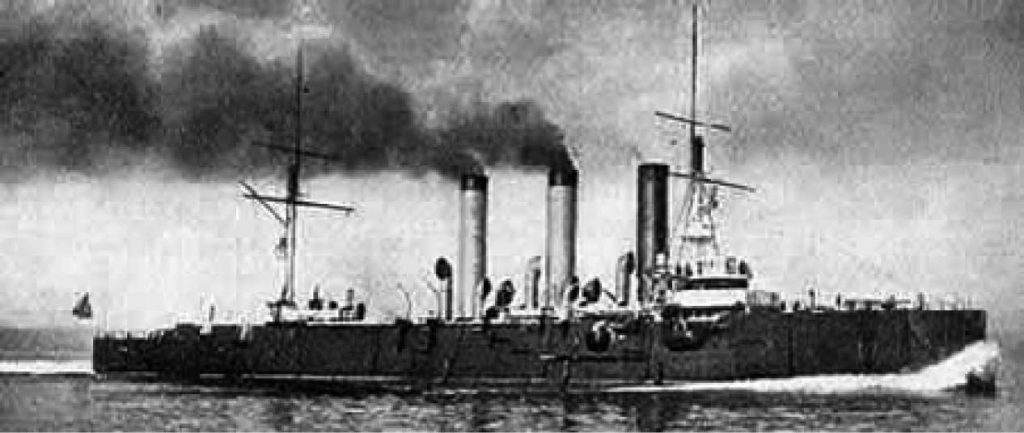
This is how the battleships Orel, Nikolai I, Apraxin and Senyavin were handed over to the Japanese. Only three ships managed to escape, among them the protected cruiser Aurora which played its part in the October Revolution. The wounded Rostestvensky was captured.
Togo received him cordially and said: “Defeat is the common fate of the soldier. There is nothing to be ashamed of. The important thing is that we both did our duty.”
In fact, the heavy Russian defeat was expected. The Russian Navy had 4,380 dead, 5,917 prisoners, including two admirals, and 1,862 men confined to neutral ports by the end of the war. The Japanese lost only three torpedo boats and had 117 dead and 500 wounded. But the most important thing was that they had destroyed the myth of the invincibility of the “white man” and had made their country, within a few hours, a world naval power.

