




A study by the American Security Project (an American think tank focused on security issues), touches on an important issue for the US Armed Forces, but it is not limited there and concerns Greece as well. In particular, the large increase in obesity among staff, which has multiple effects.
According to the recently published study titled “Combating Military Obesity: Stigma’s Persistent Impact on Operational Readiness“, 68% of US ED staff are overweight or obese, and especially for the latter, it now concerns 21.6% of the total (for 2022), a dramatic increase from 10.4% in 2012.
For the professional U.S. military, this is a big issue, initially due to a decline in applicants for enlistment. While there, 17% of those rejected for recruitment as professional soldiers were concerned with weight issues, which exceeded the relevant limits. To deal with the problem, a program of “relaxation” of the relevant criteria was launched, as long as the candidate was considered otherwise suitable, if his weight was up to 2% above the maximum. While at the same time, physical training programs were also established, before the classification, to help those interested to lose weight.
But the problem returns during the long tenure. Thus, if during the classification the new recruits are 50.6% normal weight, 40.3% overweight and 8% obese (based on the body weight index BMI), at the age of 35 only 20.7% have a normal weight %, 51.2% are overweight and 28.1% are obese! In other words, as the years go by, the staff “puts on a lot of weight” and does not seem to be losing it.
Significant differentiation also exists between Branches. Thus, 8.9% of those serving in the Marines (Body with strict weight limits and a requirement of good physical condition) are obese, in the Army the percentage rises to 18.3%, in the Air Force to 18.7% but in the Navy it climbs to 27, 1%. And within the specialties there is variation where e.g. Engineers and Intelligence officers are fatter than infantrymen or pilots.
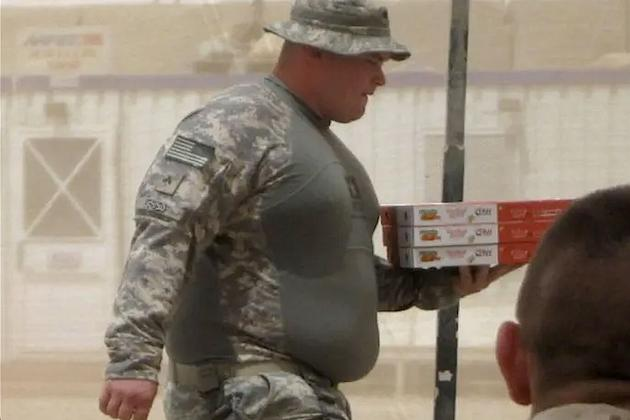
Collapse of staff health
The problems from this epidemic are many. Initially, the military’s operational efficiency decreases as their physique, and especially combatants, does not allow them to undertake intense activities, it leads to faster exhaustion, as well as the inability to carry combat loads, etc. It also becomes more and more difficult to transport them if they are injured in the field. At the same time, obesity significantly increases (up to 47%) the risk of developing health problems, from musculoskeletal, arthritic, cardiac or pulmonary injuries. Health issues due to obesity gradually accumulate, so the professional soldier gradually “declines” in performance, while greatly increasing the cost of their care, as well as dealing with long-term health issues.
“Inverse” problems also appear here. As a significant part of the staff, they report that trying to lose weight to meet the relevant requirements of their service, they take diuretics and laxatives, various diet pills, deliberately vomit after meals, or smoke to reduce the stress of a diet. In other words, they show a series of eating disorders, which becomes a vicious circle.
By another measure, overweight people leave the military 18 months earlier than people of normal weight, exacerbating the issue of downsizing. And of course retirees “inherit” all the health problems that obesity has created for them, so they follow them for life.
The study concludes – as far as the US armed forces are concerned – in a series of proposals, which include information and training programs for personnel, better measurement and assessment of body weight in relation to the requirements of the service, more systematic diagnosis and medical treatment of the issue, with referral to specialized doctors and nutritionists. It is also proposed to modernize the training plans of the staff and it is emphasized that there must be transparency in the collection of relevant data.
Moving away from this specific study, we can comment on the following: First, that the issue of increased body weight does not concern only the USA (which also has a negative record of obesity in its population), but the planet as a whole. And in the Armed Forces it has been seen in the most intense way. E.g. a study by the German army states that 40% of the personnel are overweight, while in general most do not exercise well and do not eat healthily.
But obesity as a modern issue also manifests itself in other ways: for example, old weapons systems from the 50s or 60s, such as armored personnel carriers, tanks, aircraft, jeeps, today hardly “fit” the modern soldier. And why he has gained weight and why he has grown taller (especially in countries that have seen a rapid rise in living standards). So if one looks at modern designs, e.g. of armored personnel carriers, is impressed by their bulk, which however “hides” a requirement to transport a modern battle group that not only carries a lot of material but also its members are clearly stronger than a few decades ago.

