



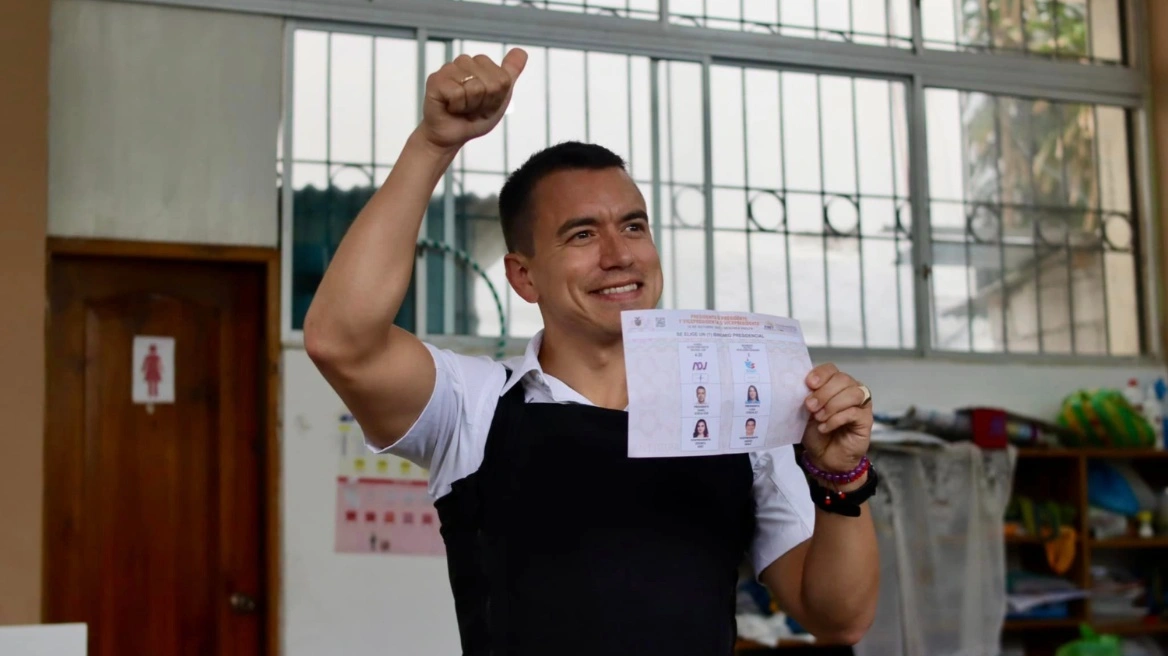
Daniel Noboa, businessman and heir to a banana magnate, won on Sunday October 15, the second round of the presidential elections held in Ecuador and will become the youngest president in the country’s history, the National Electoral Council (CNE) announced.
They received 52.30% of the vote, compared to 47.70 for his opponent Luisa González – who already acknowledged her defeat and “congratulated” the winner – and, “with more than 90% of valid votes on a national scale” to has been counted, “the CNE considers these results irreversible and that Ecuador has effectively elected Daniel Noboa president,” said the head of the institution, Diana Atamaid, during a press conference.
Car horns from supporters of Mr Noboa, 35, rang out as the results were broadcast in the capital Quito. Mrs. Gonzalez acknowledged her defeat and “congratulated the winner.”
In number of votes, Mr. Noboa gathered 4.7 million, against 4.2 million of his opponent, he had a difference of about 400,000 votes. Daniel Noboa, who made the surprise of the first round by advancing to the second, promises to attract foreign investment, create jobs and send dangerous criminals to prison ships.
Married with two children, the president-elect studied at the best American universities before joining the family business empire, Noboa SA.
Smiling but restrained, with an athletic demeanor, he promised to get tough on the gangs. He suggested “militarizing ports and borders”, better guarding “strategic export and trade routes”, increasing “civil vigilance”.
His other public safety announcements include the creation of a national intelligence agency to oversee all other law enforcement agencies, including the prison service (SNAI), which he accuses of being an “absolute disaster”, referring to repeated massacres inside detention centres. Last weekend, seven suspects in the murder of candidate Villavicencio were found murdered in prisons.
He declares himself “center-right”, however he is classified as a neo-liberal and by definition belongs to the political-economic elite that comes from the world of business.
His 76-page program has four aspects, “social, economic, institutional and environmental” and a “strategic” foundation to combat the “deeper causes of low economic growth and high levels of crime”, phenomena which he sees as linked .
The president-elect, with little – two years – experience in political matters, will have little time to make his promises a reality. He will rule until early 2025, when the term of outgoing right-wing president Guillermo Lasso, who opted to call early elections to avoid being suspended from parliament as he faced the prospect of a corruption trial, would have ended.
Mr Noboa will need to forge alliances to secure a majority in parliament, where political power is fragmented: he can count on the support of only 13 of his own members, compared to 48 for the Korean Party, out of a total of 137 seats.

