




The F-15X is the latest and most advanced version of the well-known fighter aircraft F-15 Eagle, designed and developed by the American Boeing. The F-15 first flew in July 1972 and entered service with the US Air Force in January 1976. Since then it has been significantly upgraded and evolved: From the F-15A/B Eagle versions (single and two-seat respectively, the production discontinued 1979) transitioned to the F-15C/D Eagle versions (single and two seat respectively, production ended 1985), then the F-15E Strike Eagle version (two seat, production ended 2011) and now the F-15X version . Outside of the US Air Force, Israel, Japan, South Korea, Saudi Arabia, Singapore and Qatar have F-15s in service or soon to be in service.
The F-15X is the latest and most advanced version of the well-known fighter aircraft F-15 Eagle, designed and developed by the American Boeing. The F-15 first flew in July 1972 and entered service with the US Air Force in January 1976. Since then it has been significantly upgraded and evolved: From the F-15A/B Eagle versions (single and two-seat respectively, the production discontinued 1979) transitioned to the F-15C/D Eagle versions (single and two seat respectively, production ended 1985), then the F-15E Strike Eagle version (two seat, production ended 2011) and now the F-15X version . Outside of the US Air Force, Israel, Japan, South Korea, Saudi Arabia, Singapore and Qatar have F-15s in service or soon to be in service.
The F-15X is the last link in a chain of evolution of the F-15E Strike Eagle and traces its origins to the F-15SE (Silent Eagle), F-15-2040C (proposed upgrade of the F-15C) and F-15 Advanced Eagle, selected by Saudi Arabia, Qatar and Israel. The F-15X is essentially the version of the F-15 Advanced Eagle proposed by Boeing and ultimately selected by the US Air Force to replace the F-15C/D. The F-15SE and F-15-2040C versions never went into production, but their technology formed the basis for the development of the F-15 Advanced Eagle and the F-15X. The F-15SE flew for the first time in July 2010. The aircraft is made of materials that produce a reduced radar trail (Stealth), and the tail vertical stabilizers are made with an external slope of 15° also for reasons of reducing the radar trail of the aircraft.
Also, the F-15SE incorporates Conformal Weapons Bay (CWB), while two (2) additional weapons bays have been added, one (1) on each wing. The aircraft’s primary sensor is Raytheon’s AN/APG-82(V)1 AESA (Active Electronically Scanned Array) technology radar, which combines the AN/APG-79 processor of the F/A-18E/F Super Hornet , and the AN/APG-63(V)3 antenna of the F-15E Strike Eagle. It also integrates BAE Systems’ Digital Electronic Warfare System (DEWS), Eagle Passive/Active Warning Survivability System (EPAWSS), Digital Flight Control System, Link-16 Data Link System and Infrared Search System and IRST (Infrared Search and Track).

The F-15-2040C version is an F-15C upgrade proposal based on F-15SE technologies and with an emphasis on increasing air superiority capabilities. The F-15-2040C incorporates some external radar signature reduction improvements, an IRST system, and twice the wing armament capacity of the F-15C/D (from 8 to 16 air-to-air missiles), through the adoption of the removable AMBER (Advanced Missile and Bomb Ejection Rack) dual weapon mount system at each structural mount station. It also incorporates electronic warfare and self-defense systems, compliant fuel tanks, an improved AN/APG-63(V)3 AESA technology radar, and is certified with the Talon HATE pod for real-time interface and communication with the F-22 Raptor.
An evolution of the F-15SE version is the F-15 Advanced Eagle, which incorporates almost all of the features of the F-15SE (engines and electronics, except for the aircraft’s radar signature reduction materials), but with the option of adopting the AN /APG-63(V)3, instead of AN/APG-82(V)1. It also incorporates an improved data projection system on the helmet (JHMCS II: Joint Helmet-Mounted Cueing Systems II). In indicative combat load combinations the F-15 Advanced Eagle can carry: (a) Up to 22 AIM-120 AMRAAM (Advanced Medium Range Air-to-Air Missile) or short-range AIM-9X Sidewinder air-to-air missiles (b ) Eight (8) air-to-air missiles and 28 SDB (Small-Diameter Bomb) guided bombs or (c) Eight (8) air-to-air missiles and seven (7) 2,000-pound JDAM (Joint Direct Attack Munition) guided bombs.
As we mentioned above, the F-15 Advanced Eagle version was chosen by Saudi Arabia (F-15SA : Saudi Advanced), Qatar (F-15QA : Qatar Advanced) and Israel (F-15IA : Israel Advanced), while the US Air Force chose the 2019 the F-15X version to replace the F-15C/D. Saudi Arabia has chosen the AN/APG-63(V)3 radar, while Qatar has chosen the AN/APG-82(V)1. Israel’s choice is not yet known as only last March it was decided to supply 25 F-15IAs and upgrade 25 F-15Is to the F-15IA level (and Saudi Arabia, along with the supply of F-15SAs will also upgrade the F-15S to the F-15SA level). It should also be noted that the F-15SA/QA/IA will incorporate the advanced ADCPII (Advanced Display Core Processor II) processors, which are capable of processing 87 billion instructions per second.
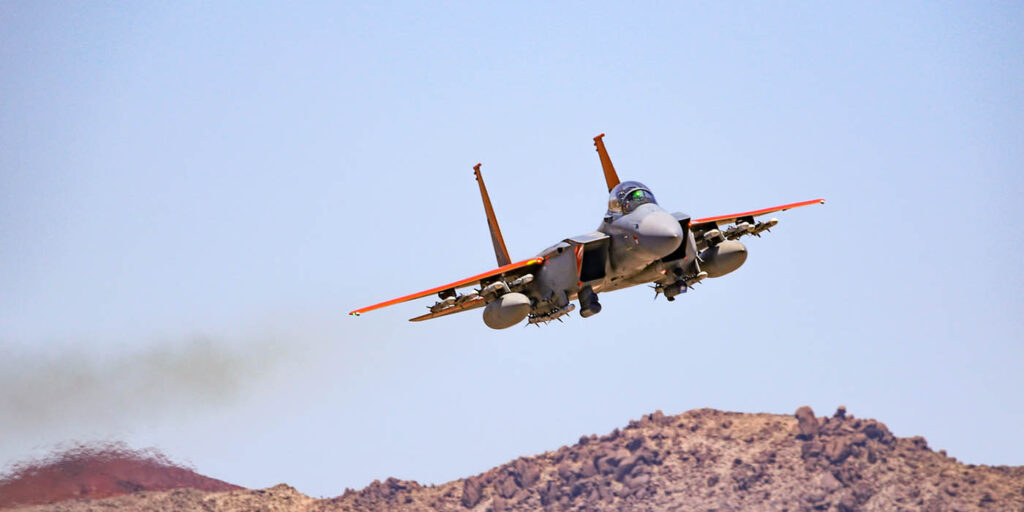
Apart from Saudi Arabia, Qatar and Israel, Japan has also chosen to upgrade the F-15J/DJ to the F-15 Advanced Eagle level. Specifically, a few days ago it became known that Boeing and the Japanese Mitsubishi signed a $4.5 billion contract to upgrade 98 F-15J/DJs to the F-15JSI/DJSI (JSI : Japan Super Interceptor) level. Boeing’s insistence on the development of the F-15E Strike Eagle and especially the development of the F-15 Advanced Eagle version is not accidental, but was based on the early termination of production of the F-22 Raptor in 2009, after the production of 187 aircraft, and to the fact that the F-15C/D are at the end of their operational life combined with the fact that they are aging faster than the rate of entry into service of the F-35 Lightning II.
The end of production of the F-22 Raptor has created a need for one more air superiority aircraft in the ranks of the US Air Force so that the projected numbers of aircraft are available. On the other hand, the aging of the F-15C/D at a rate faster than the rate of entry into service of the F-35 Lightning II will create an operational void in the US Air Force’s force structure, particularly in the 2020s. Why? because, as US Air Force officers have stated, by 2025, 230 F-15C/Ds, which entered service in 1979-1985, will have to be retired and replaced. The solution of upgrading them to the F-15-2040C level was considered, but finally the solution of the supply of new aircraft to replace the F-15C/D and the upgrade of the F-15E Strike Eagle, within the framework of the program “The F -15 Roadmap Candidate Collection’.
As it became known in March 2019, since the publication of the draft defense budget for 2020, the US Air Force will proceed with the procurement of 144 F-15X within a decade. The first order is for eight (8) aircraft for $1.2 billion, which will be delivered in 2021 (two aircraft) and 2023 (six aircraft). In total for the procurement of 144 F-15X the amount of $22.89 billion ($159 million per aircraft) has been budgeted for the aircraft, weapons and their support for 15 years (according to Boeing the Fly-Away cost of F-15X is $98.3 million today with the prospect of falling to $80.3 million in 2025, if and only if all 144 F-15X are ordered). The aircraft was designed and developed to “fit” as much as possible into the existing and pre-existing technical infrastructure of those using F-15 aircraft, so as to compress procurement and operating costs. Also, always according to Boeing, the cost per flight hour is in the order of $27,000.
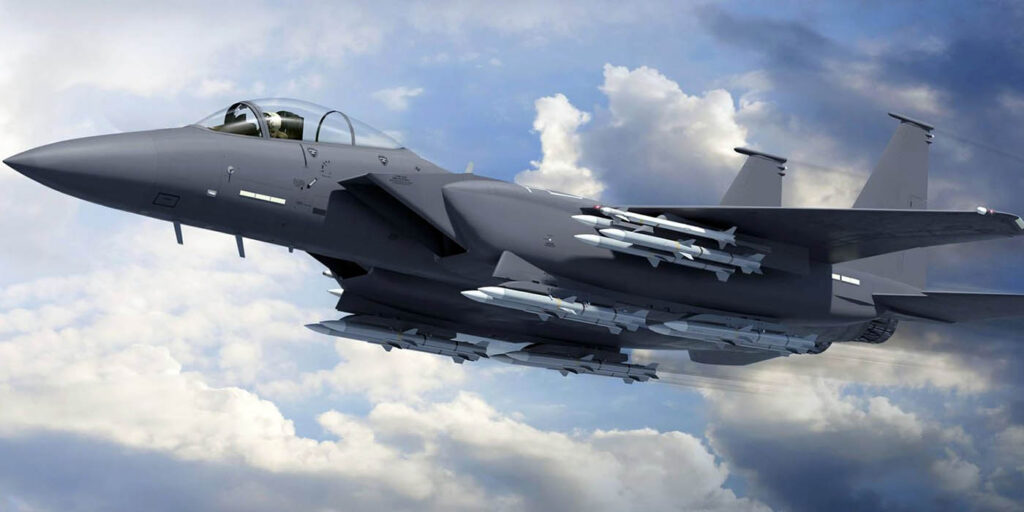
At the operational level the dilemma of new F-15X or more F-35 Lightning II has not only troubled the US, but also Israel. Perhaps the logic of Israel’s decision to choose both the F-15IA and the F-35 Lightning II is the same as the logic of the US Air Force and thus the F-15X was chosen as a replacement for the F-15C/D. In essence, while the F-15X has a large weapons carrying capacity, compared to the F-35 Lightning II, the F-35 Lightning II has a lower radar footprint, while it is at the beginning of its operational life, so it has greater prospects development. It is clear then that the catalyst that led to the selection of the F-15X is the large weapons carrying capacity of the aircraft (in total the F-15X can carry 29,500 pounds of cargo, while it has an operational life of 20,000 hours).
But it’s not just the F-15X’s large transport capacity. It’s integrated flight control system, the AN/APG-82(V)1 radar, DEWS and EPAWSS systems, the new, more ergonomic cockpit with the new single wide-angle multi-data display touchscreen, the most capable JHMCS II for two (2) pilots, infrared system IRST (AN/AAS Tiger Eyes) F100-PW-229 (Pratt & Whitney) or F110-GE-129 (General Electric) engines, delivering approximately 30,000 pounds of thrust. It should also be noted that apart from the missiles, the F-15X also incorporates one (1) 20 mm M-61A2 Vulcan cannon with a capacity of 540 rounds. In conclusion, the F-15 Advanced Eagle, especially in the Qatari (F-15QA) and US (F-15X) configurations is a modern and capable aircraft and a mature design, especially for those countries that maintain F-15s in service, while its cost is directly competitive.
The F-15X incorporates advanced avionics, AESA technology radar, integrated electronic warfare and self-defense systems, ergonomic cockpit, JHMCS II, Link-16, IRST system, powerful engines, the ability to carry a very large volume of weapons, both for air superiority missions, and and for air-to-ground missions and long flight performance (maximum range of 1,770 km with three external fuel tanks, maximum operational altitude at 60,000 feet). That is, it is an integrated air platform, an air power multiplier, capable of performing a multitude of air combat and attack air missions. It is no coincidence that both the US and Israel, Saudi Arabia and Qatar chose it, alongside or instead of the newer F-35 Lightning II.
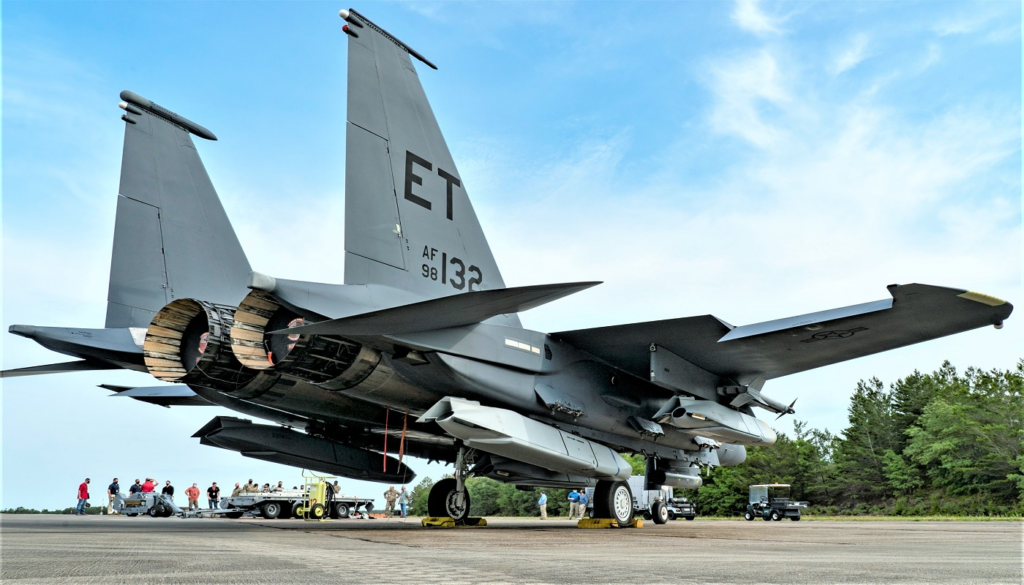
In January 2023, the US Air Force concluded that the new F-15X Eagle II fighter jets exceeded operational expectations, in the area of weapons volume transport. In early 2021 the US Air Force received the first two (2) F-15X, as part of the initial supply of eight (8) aircraft of the type (the contract was signed in July 2020, at a cost of $ 1.2 billion, the remaining six aircraft expected to be delivered within 2023). The US Air Force selected the F-15X as a replacement for older F-15s. During testing, the F-15X demonstrated its ability to carry and launch 12 AIM-120 AMRAAM medium-range air-to-air missiles.
Also, the F-15X demonstrated its ability to carry 13.6 tons of weapons. The F-15X is cheaper to buy than the F-35, more economical to operate in missions that do not rely on or require stealth technology, and more capable than the original versions of the F-35. Improvements to the F-15X, which has an operational life of 20,000 hours, allow the aircraft to perform the same bombing missions as the F-35, but at an operating cost of $29,000 per flight hour, which is less than the equivalent cost of the F- 35.


