On the German side, field marshal Gerd von Rundstedt, who bore the title of Chief Marshal of the West (Oberbefehlshaber West/abbreviated: OB West), was appointed responsible for the defense of the area of (occupied) Western Europe against the impending Anglo-American withdrawal.
All Wehrmacht units in the areas of France, Belgium and the Netherlands were under his command. On the contrary, the units of the Navy (Kriegsmarine) and Air Force (Luftwaffe) stationed there had not been directly under his command.
Specifically, their mandate stipulated that they were to follow his orders regarding coastal defense (Kustenverteidigung) within their tactical capabilities.
Thus, on the one hand, the commander-in-chief had to plan the defense of “Fortress Europa” (Festung Europa) based on the combined use of the land, naval and air forces at his disposal, and on the other hand, the naval and air units retained a part of the autonomy their.
Moreover, this practice reflects the principle of “divide and conquer” followed by Hitler, who used to divide responsibilities at the operational level in order to ensure his own decisive power at the strategic level.
In this case, the Fuhrer’s favorite tactic was expressed by his Directive number 40 (Fuhrerweisung 40), on defense in the area of responsibility of the Chief General of the West, which he issued, as Commander-in-Chief of the German Armed Forces, on March 23, 19421.
The aforementioned directive was to cause a lot of friction between the individual Arms, particularly between the Army and the Navy, with visible effects on the organization of the defense of Western Europe.
It should be noted that the Western Front had been left without reliable military cover for a long time, due to Operation Barbarossa.
Army Group A (Heeresgruppe A), considered the best of the Wehrmacht, had been withdrawn from France as early as March 15, 1941, as had Army Groups B and C (Heeresgruppen B & C).
Army Group D (Heeresgruppe D), formed in October 1940 and given responsibility for covering the Western European sector in March 1941, very quickly looked like a substitute rather than a replacement for its predecessors: its best units (15 Infantry Divisions out of the 39 he had in total) were detached, during 1942, in the direction of the Eastern Front.
They were succeeded by units with obsolete equipment and reduced combat value2.
Over time, however, and as the possibility of an amphibious action by the Anglo-Americans in occupied Western Europe increased, the German top political and military hierarchy was forced to take this possibility seriously.
Thus, by order of Chief General West (OB West) of May 7, 1944, i.e. one month before the Allied withdrawal, the commanders-in-chief of the German Armed Forces of France, Belgium and North Africa were subject to his orders, as far as all military matters were concerned .
This entailed the deployment of significant formations of Army Group B (Heeresgruppe B), under Field Marshal Erwin Rommel, as well as Panzergruppe West and Army Group G (Armeegruppe G). Furthermore, the commander-in-chief’s jurisdiction included Marine-Gruppe West and the 3rd Air Fleet (Luftflotte 3).
As far as the Navy is concerned specifically, Naval Group West, commanded by Admiral Krancke, was tasked with identifying, locating and neutralizing enemy naval units as well as defending, both with surface units and and with the coastal forces, against any hostile invasion attempt, in the offshore maritime space.
The German Navy had begun as early as 1940 to blockade important ports on the Atlantic coast with its artillery, in order to prevent a possible recapture of the ports by the British.
These were the beginnings of what later became known as the “Atlantic Walls”.
The Coastal Defense Artillery of the Navy (Kustenverteidigungsbatterien der Marine – or simply Marinebatterien) was directly under the command of the Navy, and only in the spirit of Directive number 40 to the Commander-in-Chief West.
It must be emphasized, in this case, that it was about the qualitatively best Coastal Artillery that the German side had. In addition, Land Army Artilleries (Heeresküstenbatterien) were also placed to strengthen the coastal defense against enemy invasion.
The long-known dispute between the Arms and the Services as to who had the overall command was settled in the following Solomonic solution: since the Navy had shouldered the mission of repelling an enemy landing in the maritime space off the coast, all Coast Artillery, including those of the Wehrmacht, were under the orders of the Navy as long as the target was enemy surface units and landing craft.
If, however, there was an enemy landing on land, then the general order went to the Army – from that moment on, the Artillery’s target was no longer naval but land forces.
By virtue of Basic Order No. 9 of Chief General West, of January 1944, “Battle Zones” (Kampfzonen), 20-30 kilometers long, were created in parts of the coast that were considered particularly vulnerable.
The appointed military commanders of these Battle Zones were given “unrestricted jurisdiction” over all military units within each sector in the event of an invasion. This order was clearly intended to overcome the problems of jurisdiction and responsibilities between the Navy and the Army and to ensure that there would be a uniform and effective reaction of all defense departments in the event of a landing.
Of particular interest was, in this case, the area of responsibility of the 7th German Army (AOK 7), where the Anglo-American “Operation Overlord” (Operation Overlord) was to unfold. Further, specific forts were designated within the various Battle Zones, the Commander-in-Chiefs of which were surrounded with extensive powers, so that they could fulfill the mission assigned to them, which was clearly and succinctly defined: to defend their forts until a (Written Order of the Supreme Military Command/Oberkommando Wehrmacht to the Commander-in-Chief West/OB West, dated February 5, 1944).
However, the friction did not disappear. The commanders of the forts were usually Army officers. However, as it was mainly about ports (as, for example, in the case of the port of Cherbourg, in the North, which was included in the 7th Army Zone), disagreements about responsibilities arose again.
The dissatisfaction of the Navy was caused by e.g. the fact that, suddenly, the “Bunkers” (fortified bases and bunkers) of the submarines, located within the perimeter of the forts, came under the orders of Wehrmacht officers. A new order of June 2, 1944, i.e. just four days before the invasion, attempted to break the Gordian link, limiting the – previously absolute – powers of each guard-administrator fort, as long as at least his fort had not yet been attacked or isolated under his command. enemy.
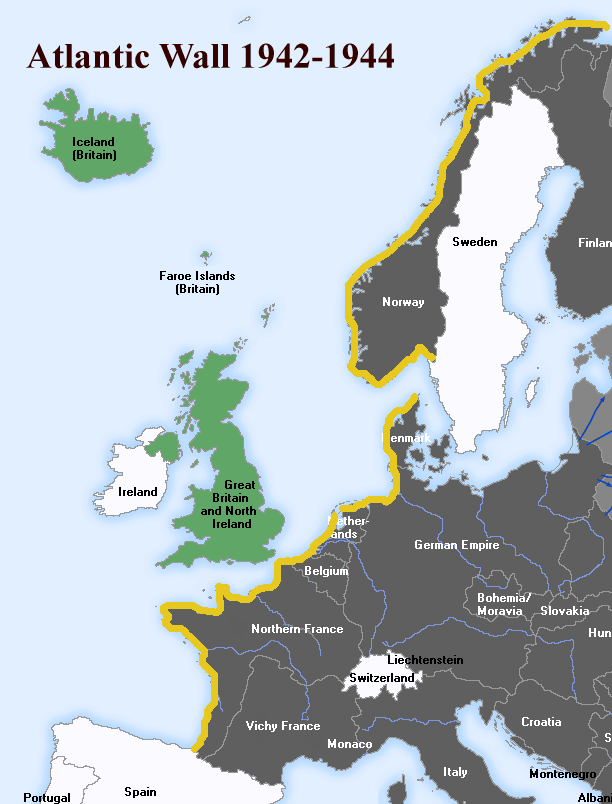
From the autumn of 1942, the existing Naval Coastal Defense Guns along the coastlines of Western Europe began to be reinforced with Army Guns. It was an undertaking of gigantic proportions: the coasts of Northern Norway, in the Atlantic, of Denmark and Northern Germany in the North Sea, of Holland, Belgium and France, along the length of the Atlantic and up to Spanish border. Also, the Mediterranean coast of France had to be covered. The operation was codenamed “Atlantik Wall” (Atlantik Wall), replacing the earlier “New West Wall” (Neuer Westwall).
The order for the construction of the latter had been issued by Hitler since the end of 1941. It initially provided for the dispersion of Infantry forces in fortified positions on the coasts, between the Artillery of the Navy and the Army. On 13 August 1942 it was decided to build 15,000 fortified positions along the French, Belgian and Dutch coasts within a year.
Of these, 4,000 were intended to be erected at the ten (10) most strategically important points, 1,000 would be used for Pak (anti-tank) and 10,000 fortified positions were planned at less important points and along the free coast. Altogether, 300,000 German troops would be stationed at fortified points along the French, Belgian and Dutch coasts.
Thus, around the end of 1942 and the beginning of 1943, an imposing system of forts and gun emplacements had been created along the Atlantic in order to cover the coastline and the maritime space in front of it from enemy invasion3.
However, due to the undeniably gigantic dimensions of the whole undertaking, due to the length of the Atlantic coast from Norway to the Franco-Spanish border, it was practically impossible to cover all parts of the coast equally. Of necessity, the center of gravity was thrown where the German commanders expected the Anglo-American landing to take place, that is, in the section between Fort Le Havre, at the mouth of the Seine, and Calais.
This part of the coast is closer to the British Isles, and it had ideal positions which, probably, the enemy would hasten to exploit during the landing. Hitler in particular seemed absolutely convinced that the Anglo-American landing would take place at Calais (driven, among other things, by his well-known love of Military History).
However, the problem for the German side was that it had far fewer men than would be required to carry out such an undertaking, which, in any case, seemed completely unrealistic even in the eyes of the German High Command, as revealed by a related declassification. of Field Marshal Rommel after completing his first inspections of the Atlantic Wall, around the end of 1943.
Thus, it is possible that the artillery units covered almost the entire length of at least those coasts that were considered unsafe, but the much-needed Infantry Divisions that would “fill” the space between the first ones were still missing. It is enough to consider that the OB West sector extended over 2,600 kilometers of coastline.
In some cases, an Infantry Company was called upon to defend 25 kilometers of coast! It becomes apparent how thinly manned the vaunted Atlantic Wall was.
The careful eye of the historian would point out, in this case, that the strategic purpose of the Atlantic Wall was not, in fact, to defend against an Allied withdrawal, but to prevent it. Indeed, German propaganda had invested heavily in the grand scheme.
The Atlantic Wall, with its imposing forts and scattered fortifications, had been reduced to a myth, reproduced by the official and unofficial channels of psychological operations, with the aim of demonstrating to the Anglo-Americans the futility of all conventional landing force.
This, of course, does not mean that concerted efforts were not undertaken, at the operational and tactical level, to defend those areas, in particular, that were considered the most likely theaters of invasion. The morale of the German side was noticeably boosted after Marshal Erwin Rommel, the legendary “Desert Fox” (Wüstenfuchs), assumed part of the responsibility for the defense of the Atlantic Wall.
The veteran commander of the Afrika-Korps was transferred on November 3, 1943 to the Western Front, under the responsibility of Chief General West.
Within a short period of time all the coastal forces of the 7th Army (Normandy, Brittany), the 15th Army (Belgium, N. France) and the Netherlands came under his command.
On February 16, 1944, the Armored Divisions stationed in this sector were added. Rommel conducted successive inspections along the Atlantic Wall and mobilized his (admitted by friends and opponents) creative intellect to solve the defensive problems of his sector.
Fortified positions and fortified bases and shelters (Bunkers) had been erected based on designs of either the Navy, the Luftwaffe or the Wehrmacht. The first Bunkers were built by the Navy. These were fortified positions that covered the Coastal Artillery of the Navy, which had the mission of protecting the most important ports.
Here it must be clarified that the terms of the Treaty of Versailles (1919), which had been dictated by the victorious forces of the Entente Cordiale to defeated Germany, prohibited the latter from possessing or acquiring Heavy Weapons (4), among them heavy artillery, but excluding certain Coast Defense Heavy Artillery Squadrons stationed in the German Islands.
This exception was to prove useful to the Germans, for these were the first Artillery the Navy placed along the Atlantic Wall: the Hamburg Artillery, with four (4) 240mm guns, moved to Herburg from Norderney, as and the Bromi Artillery, also with four (4) 150 mm guns, moved from Memel.
The first fortified positions of the Navy did not have particularly strong armor (60-100 cm). Later, however, the Navy erected imposing fortifications for its Coastal Defense Artillery as well as its submarine, torpedo boat, and torpedo boat bases. However, the complete lack of Naval Aviation, and especially Naval Patrol and Reconnaissance Squadrons, was to emerge as a serious disadvantage.
In particular, as far as AOK Battle Zone 7 is concerned, it included the Fort of Cherbourg, on the northern tip of the Cotentin Peninsula, with the Coastal Heavy Artillery Squadrons stationed there. The total number of Coastal Defense Artillery was 43. Ten (10) of them were of the Navy. The shortest range was possessed by the Beny sur Mer Artillery, with 100 thousand guns, the longest by the Cherbourg Artillery, with 380 thousand guns, the shots of which could reach 55.7 kilometers.
It must be emphasized that from the study of the disposition of the Coastal Defense Artillery, it is concluded that in the entire area where the allied “Operation Overlord” was finally conducted, there was only one (!) Naval Artillery: the Longues Artillery, with four guns of 152 thousand. In fact, right in front of the allied landing positions of June 6, 1944, the following Artillery units, all of the Army, were lined up:
Riva Bella Artillery (6 155 mm guns, 10 km range)
Quistreham Artillery (3 105mm guns, range over 12km)
Hermanville Artillery (4 105 mm guns)
Beny sur Mer artillery (4 100 mm guns)
Mare Fontaine artillery (4 105 mm guns)
Mont Fleury artillery (4 122 mm guns)
La Ferme Tringale artillery (4 105 mm guns)
Pierre Solain Artillery (4 105 mm guns)
Vaux sur Aure artillery (4 105 mm guns)
Pointe du Hoc Artillery (6 155 mm guns)
Maisy Artillery (5 155 mm guns)
The parameter touched upon here was to prove critical: The Wehrmacht Artillery, which reinforced the coastal defenses, was largely made up of spoils of war, and proved imperfect at destroying targets at long range. However, they could deal with land forces much better, since the landing action had, in the first place, succeeded and the enemy had set foot on the coast.
On the other hand, the power of the Coastal Defense Artillery of the Navy was clearly superior to that of the Army.
The Navy had guns with a higher rate of fire: the 105 mm guns with a rate of 15 rounds per minute, which could hit moving targets on the sea surface with greater accuracy.
Besides, the Navy had arranged for the supply of special optical target-locating devices, which the Army did not have.
In any case, Naval Coastal Defense was better able to deal with the enemy amphibious fleet and repel the amphibious invasion attempt while the invaders were still on the ships.
Therefore, in the light of historical study, the (at first glance, impressive) number of 43 Artillery turns out to be misleading, since, as shown, in the zone where the giant Allied landing was finally carried out, the invaders did not face more than one (1) Artillery of the Navy.
It was indeed fortunate for the Allies that they did not have to face the better quality German Coastal Artillery, namely those that the Navy had at Le Havre and Cherbourg.
Despite the miscalculations, incomplete information or even the obsessions of the German leadership, the Allies chose the coasts that have since been named “Omaha” and “Utah” to carry out the largest landing in history.
It is also indicative that in the departure area of XXX. British Army Corps and the III Canadian Infantry Division there was only one Coastal Defense Artillery.
It is, of course, an irony of history that the Herburg Artillery, the pride of the German Navy, was conquered not from sea but from land, by the 7th American Army Corps, at a later time and after the landing had, in the meantime, been crowned with success.
The importance of the absence of Naval Aviation has already been discussed. Nevertheless, the Reichskriegsmarine made strenuous as well as admirable efforts to carry out the (excellent) mission of naval patrol and reconnaissance, with the 650 or so vessels at its disposal, forced to operate at night or in adverse weather conditions.
At the same time, the Navy had also shouldered the task of mine-laying in the sea area in front of the Atlantic coast, which it also tried to accomplish with the available means.
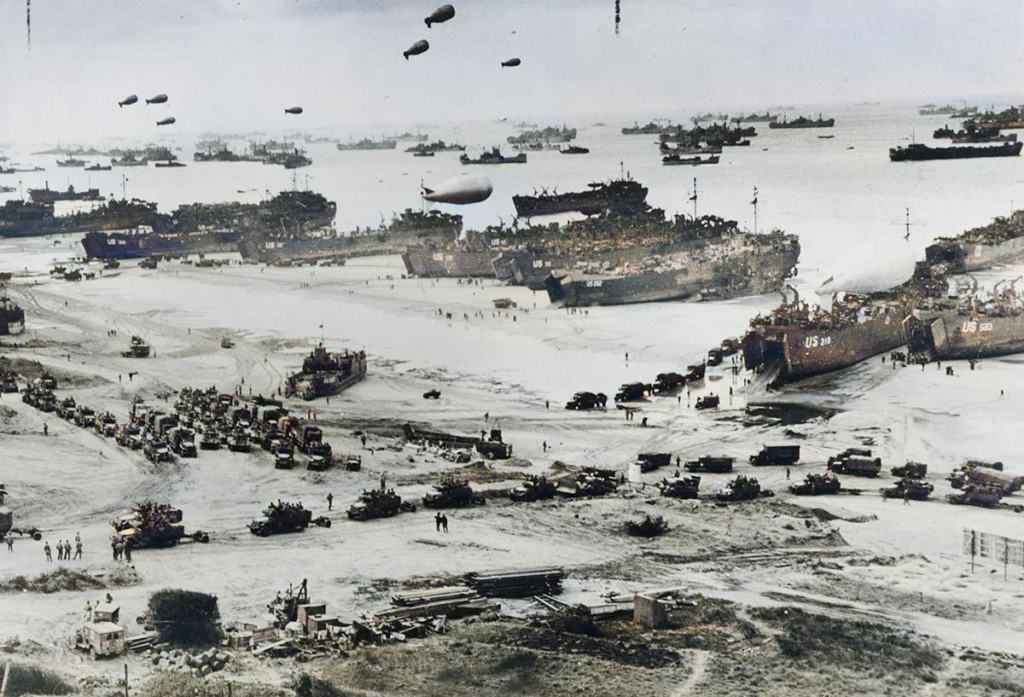
A serious disadvantage of the German side, moreover, was the substantial lack of combat surface units, with which the allied amphibious fleet would have to be faced.
If it is true that the Navy was the great wronged of the three Arms (either because of the proverbial indifference of the “continental” minded Hitler to the phenomenon of sea power or as a result of the “psychosis” of the head of the War Economy Goering with the Luftwaffe) or “simply” because the Navy paid the price for the unimaginable waste of resources and means in the adventurous “Unternehmen Barbarossa” from 1941), then nowhere is perhaps this disadvantageous position of the Navy within German Strategic Planning more vividly illustrated than in of the Atlantic Wall:
Naval Group West was essentially deprived of those combat surface units required to engage the enemy’s amphibious fleet and deter the invasion where it could be deterred: in the water – before the enemy forces established a land bridgehead.
The numbers speak for themselves: to deal with about 5,000 Allied ships, the German Navy provided one (1) Torpedo Squadron, with 4 combat units, and 4 Fast Boat Squadrons, with a total number of about 20 units. The account of the action of the surface units of the Navy during the day of the departure in the sector e.g. of the “Bridgeway Sword” was as follows: three (3) German torpedo boats fired at the (infinitely more) enemy ships, firing a total of 18 torpedoes.
In conclusion, for reasons of historical justice, it should be noted that the German Navy fought the battle under very adverse conditions and because of the absolute air superiority of the opponent: “The enemy’s monopoly of air power existed throughout the invasion”, when ascertaining of Major Friedrich Hayn.
The German misjudgment of the situation continued even after the landing in Normandy. Even on the afternoon of 6 June, the Allied operation was considered a diversion rather than the main Anglo-American operation, which continued to be expected in the Pas de Calais – which resulted in the 15th Army remaining in its positions and not being sent aid for the neutralization of the four created pre-bridges. It was not until June 12 that the strategic importance of Operation Overlord became clear to the German High Command.
In the end, the operation succeeded because the attacker acted with overwhelming firepower on a part of the long Atlantic coastline favorable for such an operation, and in which the defender did not expect it to occur – without, of course, that this meant that both the camps were not required to pay a heavy blood tax.