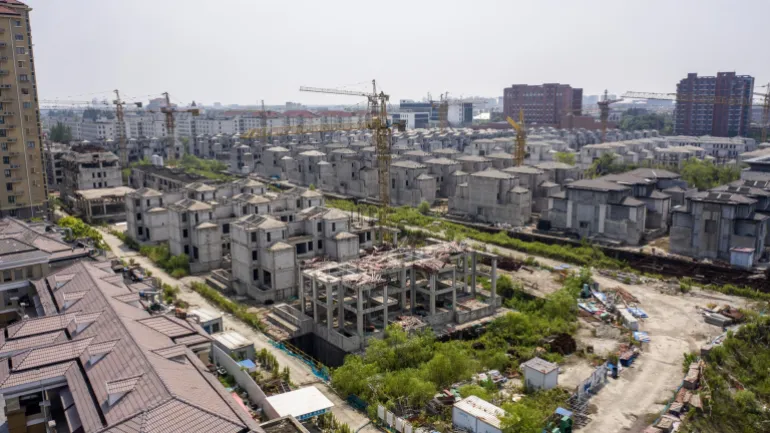
Early US capitalism was centered in New England. After a time, the pursuit of profit led many capitalists to leave this region and move production to New York and the mid-Atlantic states.
“Rust Belt”
Much of New England was left with abandoned factory buildings and towns whose depressing images are evident to this day. Eventually, employers moved again, leaving New York and the Atlantic for the Midwest. The same story repeated itself when the center of capitalism moved to the westernmost states (Far West), the South and the Southwest.
Descriptive terms like “Rust Belt,” “deindustrialization,” and “industrial wasteland” are increasingly being used in more and more parts of US capitalism.
Much of New England was left with abandoned factory buildings and towns whose depressing images are evident to this day. Eventually, employers moved again, leaving New York and the Atlantic for the Midwest. The same story repeated itself when the center of capitalism moved to the westernmost states (Far West), the South and the Southwest.
Descriptive terms like “Rust Belt,” “deindustrialization,” and “industrial wasteland” are increasingly being used in more and more parts of US capitalism. In recent decades, however, many capitalists have moved production facilities and investments out of the US, to other countries, especially China.
Continual strife and far greater anxieties accompany this capitalist exodus. Even the famous high-tech industries, arguably the only remaining powerhouse of US capitalism, have invested heavily elsewhere.

Since the 1970s, wages have been much lower abroad and markets have grown faster there as well. More and more American capitalists had to leave or risk losing their competitive advantage over those (Europeans and Japanese as well as Americans) who had moved to China earlier and were showing astonishingly improved rates of profit (we recomend you to read the book titled “”USA Global Strategy to Remain the Planet’s Superpower”, By Athanassios Chonthrogiannis, www.amazon.com)
The system rewards the already rich
Beyond China, other countries in Asia, South America, and Africa also provided incentives of low wages and developing markets, which eventually prompted American, and other, capitalists to relocate investment there.
The advantages of these movements stimulated interest and provided the incentive for even more such investments. Rising profits flowed back to the US to propel US stock markets, yielding vast resources in income and wealth.
This mainly benefited the companies’ already wealthy shareholders and their top executives. They in turn financed the promotion of ideological claims that capitalist “immigration” from the US was actually a great gain for American society as a whole. These claims, categorized under the headings of “neoliberalism” and “globalization,” served to hide or mask a basic fact: Higher profits especially for the wealthiest were the primary goal and result of capitalist flight from the United States. .
Neoliberalism was a new version of the old economic theory that justified their “free choices” as the necessary means to achieve optimal efficiency for the economy as a whole.
“Globalization”
According to the neoliberal view, governments should minimize any regulation or other interference in the profit-making decisions of capitalists.
Neoliberalism heralded “globalization,” a term specifically preferred for capitalists’ choice to move the production process abroad. This “free choice” was said to allow for “more efficient” production of goods and services because global resources could be utilized.
The meaning and strong message emanating from the exaltation of neoliberalism, free choices of capitalists and globalization was that all citizens benefited when capitalism spread.
With the exception of a few dissenters (including some trade unions), politicians, media and academics have largely joined in the loud cheers for his neoliberal globalization. Its speculative movement, however, caused its current crisis in its old centers (Western Europe, North America and Japan).

China has the advantage
First, real wages there have stagnated. Employers who could export jobs (especially in manufacturing) did so. Employers who couldn’t (especially in the service sectors) automated them.
As job opportunities in the US stopped growing, so did wages. As globalization and automation boosted corporate profits and stock markets while wages stagnated, the old centers of capitalism saw an extreme widening of the gap between income and wealth. Deeper social divisions followed, now culminating in the capitalist crisis.
Second, unlike many other poor countries, China possessed the ideology and organization to ensure that capitalist investments served its development plan and economic strategy.
China required newly arrived investors to share advanced technologies (in exchange for their access to low-wage Chinese labor and fast-growing Chinese markets). Capitalists entering the Beijing markets also had to facilitate the collaborations of distribution networks in their home countries with Chinese producers.
Party and state
Its strategy of prioritizing exports meant that it had to ensure access to these distribution systems (and thus to the corresponding capitalist-controlled networks) in its target markets. Mutually profitable partnerships developed between China and global distributors such as Walmart.
Beijing’s “socialism with Chinese characteristics” included a strong political party and development-oriented state. Together they supervised and controlled an economy that combined private and state capitalism.
In this model, private employers and government employers each direct masses of workers to their respective enterprises. The operation of both sets of employers is subject to the strategic interventions of a party and a government determined to achieve their economic goals.
As a result of the way it has defined and operated its economy, Beijing has gained more (especially in GDP growth) from neoliberal globalization than Western Europe, North America and Japan. China has grown fast enough to now compete with the old capitalist centers.
The short-sighted US response
The negative attitude of the US in a changing global economy has contributed to the crisis of US capitalism. For the US empire emerging from World War II, China and its BRICS allies (Brazil, Russia, India and South Africa) represent the first serious, sustained economic challenge.
The official reaction of the United States to these changes has so far been characterized by a combination of resentment, defiance and denial. Certainly, it is not a solution to the crisis nor a successful adaptation to a changing reality.

Third, the Ukraine war has revealed key implications of the geographical shifts of capitalism and the accelerating economic decline of the US relative to China’s economic rise. Thus, the US-led sanctions war against Russia failed to crush the ruble or cause the collapse of the Russian economy.
Elusive “American Dream”
This failure is largely related to the critical support Moscow received from the alliances (BRICS) already formed around China. These alliances, enriched by the investment of both foreign and domestic capitalists, especially in China and India, provided Russian exports with alternative markets when sanctions closed Western ones.
The pre-existing income-wealth gap in the US, exacerbated by the outsourcing and automation of high-paying jobs, has undermined the economic base of that “huge middle class” to which so many workers believed they belonged.
In recent decades, the increased cost of goods and services has made workers who thought they would enjoy the “American dream” realize that it is beyond their means. Their children, especially those forced to borrow money to attend university, found themselves in a similar situation or worse.
Counterattack
All kinds of resistance (union leadership, strikes, left and right “populisms”) developed as the living conditions of the working class continued to deteriorate. Making matters worse, the media celebrated the spectacular wealth of those few who benefited most from neoliberal globalization.
In the US, phenomena such as former President Donald Trump, independent Vermont Senator Bernie Sanders, white supremacy, union organizing, strikes, outright anti-capitalism, “culture” wars and often outlandish political extremism reflect deeper social divisions.
They feel betrayed
Many in the United States feel betrayed after being abandoned by capitalism. Their differing explanations for this betrayal exacerbate the widespread sense of crisis in the nation.
The global relocation of capital has helped to increase the total GDP of the BRICS nations (China + allies) well above that of the Group of Seven (US + allies). For all countries in the Global South, their appeals for development aid can now be addressed to two potential recipients (China and the US), not just the one in the West.
When Chinese entities invest in Africa, of course their investments are structured to help both donors and recipients. Whether the relationship between them is imperialistic or not depends on its particularities and its net profit balance.
Profits for the BRICS
These gains for the BRICS will likely be significant. Russia’s need to adjust following Ukraine-related sanctions against it not only led it to lean more heavily on the BRICS, but also intensified economic interactions between its members.

Existing economic ties and joint programs between them increased. News travels fast. Thus, it is not surprising that other countries in the Global South have recently applied to join BRICS.
Capitalism has moved, leaving its old centers, with the result that the exacerbation of its problems and divisions leads to crisis. Because profits still flow back to the old centers, those who collect them are deluding their countries and themselves that all is well domestically and for global capitalism. But because these gains sharply exacerbate economic inequalities, social crises there deepen.
For example, the wave of labor activism sweeping nearly all US industries reflects anger and resentment against these inequities. The hysteria over the scapegoating of various minorities by right-wing demagogues and movements is another reflection of the worsening difficulties.
Still another is the growing realization that the problem, at its root, is the capitalist system itself. All these are elements of today’s crisis.
A critical social question
Even in the new dynamic centers of capitalism, a crucial socialist question returns to agitate people’s minds. Is the workplace organization of the new centers – maintaining the old capitalist model of employers versus workers in both private and state-owned enterprises – desirable or sustainable?
Is it acceptable for a small group of employers to make most of the key decisions in the workplace (what, where and how to produce and what to do with the profits) exclusively and recklessly?
This is clearly undemocratic. Workers in the new centers of capitalism already doubt the system, and some have begun to challenge it and move against it.
Where alternatives to socialism emerge in these new centers, workers are most likely (and soonest) to resist their submission to remnants of capitalism in their workplaces.