

The four countries of central Europe and the EU respectively Poland, Hungary, Slovakia and the Czech Republic are known as the countries of the “Visegrad” Group and as partially former territories of the Austro-Hungarian empire that faded after the end of A World War (1914-1919), present a firm political preference for ultra conservative and extreme right for at least fifteen years from the date of their entry into the EU and so far.
by Thanos S. Chonthrogiannis
It is prohibited by intellectual property law or in any way illegal use of this article, with heavy civil and criminal penalties for the offender.

Photo by Crazy Phunk,
https://en.wikipedia.org/wiki/Public_domain
Despite their obligation to introduce and adopt in their society and lifestyle the liberal political institutions of the EU, the peoples of these countries continue to vote in favour of ultra-conservative parties giving them the government, the last fifteen years.
It is by chance that this fact or is based on the chronic lack of culture of liberal political institutions due to the authorisation of communism that kept in “prison” all these peoples, as in Russia respectively, with the result that they continue the same political behavior to date.
Or is the economic boom that has occurred in these countries because of their entry into the EU is the main factor that these people believe is due to their authoritarian leaderships, with the result that they continue to vote for them and give them the executive power?
The current political landscape in the Visegrad countries
On 20 October, the national elections in Poland were the winner of the populist ‘Law and Justice’ party (PiS), which has often engaged the EU for violating the rule of law, violation of human rights and its authoritarian, homophobic and xenophobic behavior.
In the recent elections triumphed with a rate of 45,38%. The Liberal Alliance only received 27% to 12.5% of the Left Alliance that entered Parliament (Goal KE (PO+SSL), 38,47%). But the “Law and Justice” party lost control of the Senate (it captured 61 at 100 seats in 2015, while in the recent elections it received 48 from 100 seats). A development that shows that the Principal opposition will be able to exercise greater scrutiny in future in the legislative power.
At the same time on 20 October, local elections were held in Hungary. The candidate mayor of Budapest supported by the party of the President of the government and Prime Minister of Hungary Viktor Orban defeated losing the capital’s mayor. But Viktor Orban’s party won the election in the region of the country.
In the Czech Republic the party of the ANO (Yes) of Andrej Babis-politician and oligarch-won the elections of 2017. The current Czech Prime Minister-Andrej Babis was formally accused in October 2017 for Illegal subsidies received one of his company from an EU funds.

Photo by Chancellery of the Prime Minister of Poland,
https://en.wikipedia.org/wiki/Public_domain
In Austria in the recent elections, the Conservative Party of Sebastian Kurz won 37,5%, escaping from the embrace with the Austrian extreme right that continually caused headaches in Brussels (EU).
It is an impressive political phenomenon that the persistence for now fifteen years of this ideological power of authorisation, Euro-skepticism, conservatism with emphasis on strong leadership sweeping the countries of the Visegrad group and in general the former territories of the Austro-Hungarian empire, including the Italian north. An ideological stream that dislikes strangers and pandering to racism.
The economic boom of the Visegrad countries
Fifteen years after the entry of the Visegrad countries into the EU, these countries have remarkable achievements in the economic field and the improvement of the standard of living of their peoples.
A very powerful argument that may explain why the peoples of these countries vote in the leadership of their countries in particular ultra-conservative and nationalist parties, believing that the leaderships of these parties are responsible both for the present economic boom of their countries and for the continuous increase in the standard of living of their peoples, which achievements the people of Poland, Hungary, Slovakia and the Czech Republic respectively believe that they can protect them from the likely incoming migrants in their own countries.
Looking at the following Graphs we can have an insight into the economic boom that the economies of these four countries have experienced over the last ten years. In Graph 1, is depicted the Real GDP per capita in PPPs terms.

We can observe that all countries have succeeded in increasing it (with the highest percentage being held by the Czech Republic). In 2008 the GDP per capita was for Hungary (€10370,0), for Poland (€7980,0), for Slovakia (€10800,0) and for the Czech Republic (€15190,0) with the Eurozone-19 (€29730,0). The 2018 the GDP per capita It was formed in Hungary (€12560,0), Poland (€12430,0), Slovakia (€15560,0), Czech Republic (€17640,0) and Eurozone-19 (€30930,0).
The corresponding percentage increase in GDP per capita in this decade for these countries was Hungary (21,11%), Poland (55,76%), Slovakia (44,07%), Czech Republic (16,12%) and the Eurozone-19 (4,03%). Extremely impressive achievements. The Czech Republic from the outset with its velvet divorce with Slovakia held in its territory the whole of industrial production of Czechoslovakia and for this started with high GDP per capita (more mature market) compared to the other three countries of Visegrad.
In Graph 2, is presented the Real GDP Growth rate for the Visegrad countries.

We see that the real growth rate of all four countries and after 2013 are in their entirety greater than the corresponding real growth rate of the Eurozone-19. This is something to be expected because their economies should converge and enter at some point in the phase of economic maturation, presenting growth rates close to the Eurozone-19 average.
In Graph 3 below, we see how the annual unemployment rates in these countries were initiated in the decade (2008-2018).
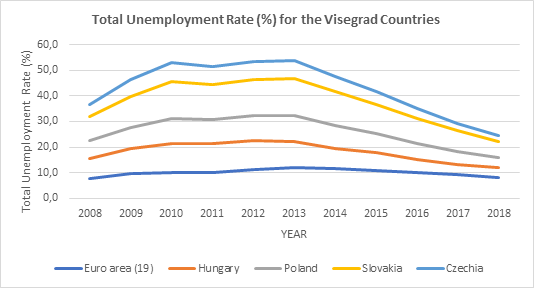
We are again seeing that unemployment in all four countries of the Visegrad group has steadily been decrease since 2013 and are likely to converge in the coming years with the average annual unemployment rate presented by the Eurozone-19.
The causes of the economic development of the Visegrad countries
The reasons for this truly impressive economic development of the countries of the Visegrad group can be summarised in the following five. More specifically,
1. In the high number of subsidies from the EU structural funds that have been taking over the years these countries have resulted in a drastic increase in the annual national income of these countries.
2. The spewed-sized investments made in these economies by Germany and given that in geopolitical terms the countries of Visegrad group historically belong to the geopolitical sphere of influence of Germany.
3. The cheap labour force offered by these countries within the EU, which was the main reason for Germany’s investment qualification.
4. The cash flows of remittances sent by immigrants-citizens of these countries back to their countries. With their entry into the EU, these countries could not sustain to employ and feed their entire population, resulting in a significant proportion of their population being left in other Eurozone countries with their main destination being Germany, and in exception to Slovakia which the largest percentage of migration was led back to the familiar for them Czech Republic.
During these fifteen years, the economies of the four countries of Poland, Hungary, Slovakia and the Czech Republic have followed the path of poor countries which, due to the above four causes, have developed very faster than the rich countries (catch-up effect) and given their cheap workforce.
As a result, wages were increased which in turn fuelled the increase in demand and consumption in the economy. In this economic context, investments continue to be made by increasing demand for more labour and from other countries in Europe by creating real conditions of prosperity in these countries spreading their good of social welfare to all citizens and regardless of the size of their income.
This is the main reason why the people of these Central European countries in the last fifteen years are voting in favour of ultra-conservative parties for the executive power of their countries.
Essentially, these peoples believe that all these economic achievements are due to these ultra-conservative power parties and to the applied management of the economy by these and which have led to economic growth and the improvement of their standard of living.

Photo by photographer, https://en.wikipedia.org/wiki/Public_domain
The difficult phase of economic maturation
But once these rapidly growing economies reach a marginal point of economic growth, their economies enter what is called the maturation phase following low growth rates, higher percentages unemployment, smaller size of investments from abroad, etc.
Our figures show that at this crucial point are the economies of the countries of the Visegrad group just before their time of entry into the phase of economic maturation. In addition, they tend to eliminate all these causes that contributed to achieve this 15-year ‘economic marvel’.
More specifically, labour costs have increased indicating that investors in the real economy will in turn search for other countries-destinations with cheap labour cost to steer their investments.
In addition, Germany’s largest investor and trading partner in these countries has entered a phase of economic contraction of its GDP (recession) (for more about these please read the analysis titled “By What Policies will Germany overcome the impeding recession“), meaning that sooner or later this item will be seen in the decline in demand and consumption of the German society that will hit the Visegrad countries’ exports to Germany. Hungary and Slovakia are even more dependent from Germany on their trade and investment.
The decrease in exports and investments will bring a contraction of production levels in the countries of the Visegrad group, resulting in a gradual increase in unemployment. Which increases unemployment will cause if not social unrest certainly big political costs for the rule parties of these countries.
At the same time, the growth rate to date and the GDP growth of the countries of the Visegrad group has made them to belong at the club of the developed countries in the Eurozone, thereby losing very important share of the structural EU funds, which to date supported their economies and increase their national income.
Moreover, the loss of Britain by the EU will force the rest of the EU member-countries, notably Germany and France, to increase their participation rates in the financing of the EU budget. The participation of the countries of the Visegrad group in the financing of the EU budget is most likely to be requested.
The policies that will continue to fuel the economic development of the “Visegrad group” countries
For all the above reasons we believe that the governments of these four countries should implement specific policies to continue their growth smoothly and delay the entry of their economies into what is called phase of economic maturation. They should:
1. To replace equivalently in size the loss of funds coming from the structural funds of the EU and increased their national income to date as well as the cash flows that are directed by the remittances of their migrants-citizens to their countries.
This will be achieved through the borrowing of the general government of these countries from the global capital markets. Funds that will then direct to finance on a consistent basis the improvement and upgrading of state infrastructures through the public investment programs from the state budget of these countries.
The general government debt of these countries as a percentage of their annual GDP (2018) (Source: Eurostat) is for Hungary (70,2%), Poland (48,9%), Slovakia (49,4%), Czech Republic (32,6%), when the Euro-area-19 equivalent is (85,9%).
Poland, the Czech Republic and Slovakia could borrow in the long term from the bond markets (the yields of the respective 10-year bond for Poland, the Czech Republic and Hungary are respectively 1,962%, 1,349% and 1,890% (1/11/2019)), while Slovakia can borrow at negative interest rates (-0,100%) since it belongs to the Eurozone-19.
In this way they could increase their public debt levels to 60% of their GDP and would be consistent with the Treaty of Maastricht, while Hungary could increase its public debt ratio to 80% of its GDP respectively.
2. These resources, in addition to financing projects for the improvement and upgrading of state infrastructures (ports, motorways, railways, airports, public hospitals etc.) should be redirected through the banks in the financing of innovative enterprises and in the field of Research and Development (R&D) with aim to approach the Eurozone average.
The Eurozone-19 spends 2,5% of its annual GDP on Research & Development (R&D), while the corresponding percentages for the Visegrad countries are Hungary (1,35%), Poland (1,03 %), Slovakia (0,88%) and Czech Republic (1,79%) (Source: Eurostat, https://ec.europa.eu/eurostat/tgm/table.do?tab=table& init=1&language=en&pcode=tsc00001&plugin=1, 2/11/2019).
In addition, resources should be invested in education and upgrading the skills of workers who do not have university education. The aim should be to continually upgrade the skills of the entire workforce who presents the minimum skills.
3. As long as the funds acquired through borrowing will continue to feed the growth rates of their economies then their governments will have to implement policies that will increase the available labour force of their countries.
The simplest, fastest and low-cost policy is the influx of migrants into their countries that will redirected for work and will help, in addition to all others, and to strengthen their countries “social security funds” through their social security contributions.
However, this method has impact so far in the racism and xenophobia that it possesses in these societies of Central Europe and their respective governments. But when their governments find out that the fall in growth rates and the rise in unemployment rates will turn into big political costs, at the risk of losing the elections, we will see whether to change tactics.
Other policies to increase the available workforce are of high cost and of dubious efficiency, such as increasing childcare allowances to enable women to enter the labour market.
In the coming years it will be interesting to see how, and which effective policies will be implemented by the governments of the four countries of the Visegrad group to preserve the economic well-being of their countries.
If, on the other hand, they fail, then it is likely that the electorate in these countries would turn to other liberal political solutions by reversing the ultra-conservatism and xenophobia that their current governments represent.

