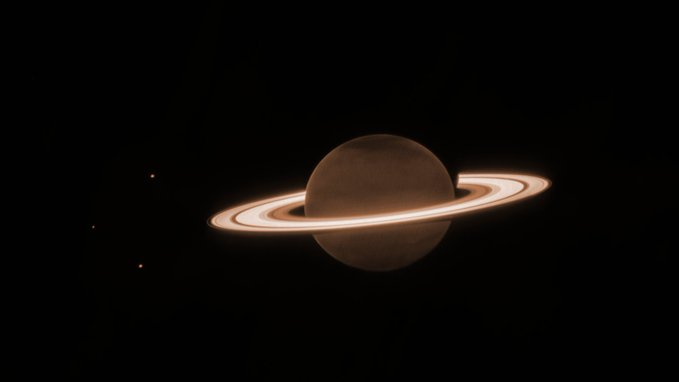
An impressive image of Saturn, its rings and moons, presented by NASA’s James Webb Space Telescope. The particular image that “excited researchers”, according to NASA itself, is the first of this planet “taken” with the telescope’s infrared camera.
Saturn appears quite dark in this infrared frame set by the telescope, as the methane absorbs almost all sunlight falling on its atmosphere. However, the “frozen” rings remain relatively bright.
This image was taken as part of the Webb 1247 observing program, which aimed to test the telescope’s ability to detect moons around the planet and its bright rings.
The image released by NASA shows details within the ring system and many of the planet’s moons, including Dione, Enceladus and Tethys. To date, 145 moons of Saturn have been identified.
The discoveries about Enceladus
A team of scientists discovered earlier this year new evidence that the subsurface ocean of Saturn’s moon Enceladus contains phosphorus, a key building block for life.
The team used data from NASA’s Cassini mission, which has been exploring Saturn and its system of rings and moons for over 13 years. The spacecraft discovered Enceladus’ subsurface liquid water and analyzed samples from a cloud of ice grains and gases ejected from cracks in the moon’s icy surface. Analysis of one class of salt-rich ice grains showed the presence of sodium phosphates.
“We found abundant phosphorus in samples of plume ice ejected from the subsurface ocean,” says Christopher Gline, a leading expert in extraterrestrial oceanography at the Southwest Research Institute in San Antonio and one of the authors of a paper in the journal Nature describing the research.
Phosphorus in the form of phosphates is vital for all life on Earth. It is essential for the creation of DNA and RNA, energy-carrying molecules, cell membranes, bones and teeth in humans and animals, and even the microbiome of sea plankton.
“We found phosphate concentrations at least 100 times higher in plume-forming lunar ocean waters than in Earth’s oceans,” Gline explains, adding, “This is a surprising result for astrobiology and a major step forward. in the search for life beyond Earth”.