



In a campaign to push back the Indians eastward, the 7th US Cavalry under Lt. Col. George Armstrong Custer, is surrounded by overwhelmingly superior Indian forces and dispersed, himself falling fighting with his men.
It is one of the worst defeats in the history of the US military and had a huge impact, not only because of the collapse of the modern military’s image of superiority over the natives but mainly because of Custer’s popularity.
A veteran of the American Civil and Indian wars himself, he had built up a huge reputation as a capable and impetuous cavalry commander who was undaunted by anything. Propaganda by the US government, the Army and the press fueled this reputation to their advantage. Although he fell momentarily out of favor due to his statements about the corruption of top military and political leaders, he rejoined the army ahead of the Great Sioux War.
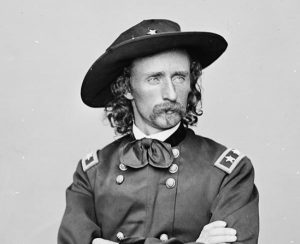
Cavalry Lt. Col. George Armstrong Custer in 1864. His career literally took off with the American Civil War, thanks to his administrative and organizational skills, his aggressive spirit, and by purging the Army’s professional officer corps of those who came from the South.
Leading the 7th Cavalry as the vanguard, he attacked an Indian camp thinking he would surprise them, but instead found himself surrounded by concentrated forces of the Lakota, Dakota, Cheyenne, and Arapaho tribes. Five of the 12 islands of the 7th Regiment were destroyed. Along with Custer, his two brothers, a nephew and a son-in-law, 268 were killed and 55 wounded out of a total of 647 men. Indian casualties were not recorded.
Custer’s defeat at Little Big Horn shook public opinion and raised a storm of reactions mainly against his subordinates, who, commanding the other units of the 7th Regiment, did not come to his aid. What shocked the public most was that Custer’s image had become associated with the romantic notion of white supremacy in the new, virgin lands, so his death at the culmination of this effort seemed incomprehensible.
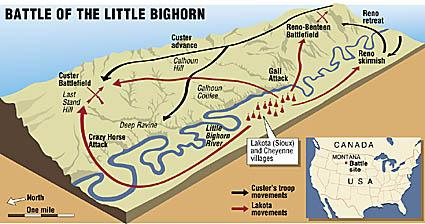
Today, historical research has proven that Custer’s star was not as bright as it was presented and that he himself came into conflict with his superiors and inferiors having created many dislikes. The Little Big Horn made several tactical errors, with several of the most significant being charged to his picks.
Finally, the triumph of Indian unity, which managed to defeat an elite body of American cavalry, was a moment of greatness but also a curse. The negative impact of the slaughter of the American soldiers, the dismemberment of the corpses and the removal of scalps and personal effects (common practices and war customs of the Indians), removed the last reservation of their humane treatment.
Henceforth, public opinion demanded that they be exterminated if settler caravans were to reach the US West Coast. The American government mobilized great forces by asking the Indians the dilemma “Sell or Starve” (sell your land or die of hunger). The Sioux thus lost all their land and their populations were confined to camps.

