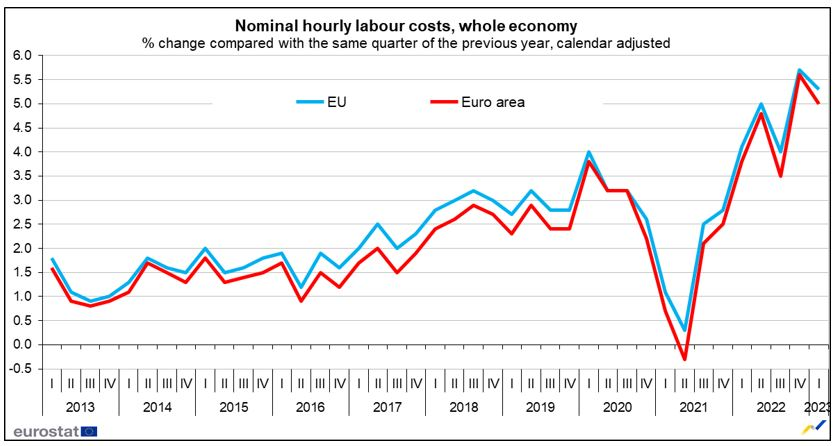
Labor costs increased by 5.0% in the first quarter of 2023 in the euro area and by 5.3% in the EU, compared to the same quarter of the previous year, as announced on Friday 17th, Eurostat, the statistical office of the European Union .
The two main components of labor costs are wage and non-wage costs (insurance contributions and other deductions). In the eurozone, wages and hourly wages increased by 4.6%, while non-wage costs increased by 6.2% year-on-year, while in the EU they increased by 5.0% and 6.1% respectively in the first quarter of 2023.
Distribution by economic activity
Based on economic activity, hourly labor costs in the euro area rose by 4.1% in the (mostly) non-business economy and by 4.9% in the business economy: +4.9% in industry , +4.1% in construction and +5.5% in services. In the EU, it respectively increased by 4.4% in the (mainly) non-business economy and by 5.5% in the business economy: +5.5% in industry, +4.4% in construction and +5.8% in services .

Hourly wage costs between countries
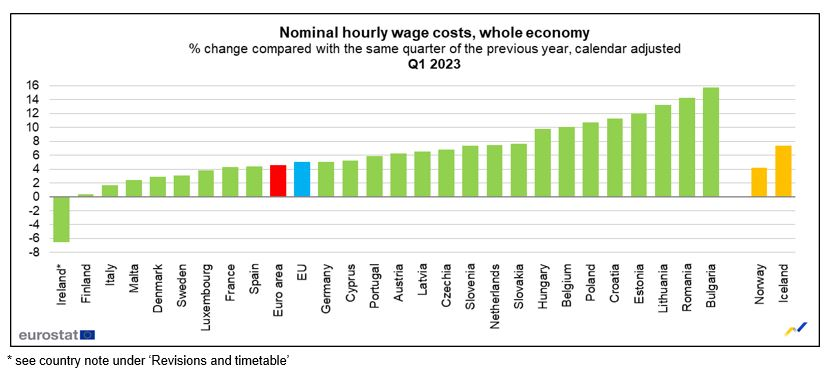
The highest wage increases were recorded in Bulgaria (+15.7%), Romania (+14.3%) and Lithuania (+13.2%), while four more EU Member States recorded increases of more than 10%, namely: Estonia (+12.0%), Croatia (+11.3%), Poland (+10.7%) and Belgium (+10.1%).