



For decades, North Africa has been Europe’s main supplier of fossil fuels, with oil and gas fields pumping out millions of barrels a month and powering cars and heating homes from Athens to Aberdeen.
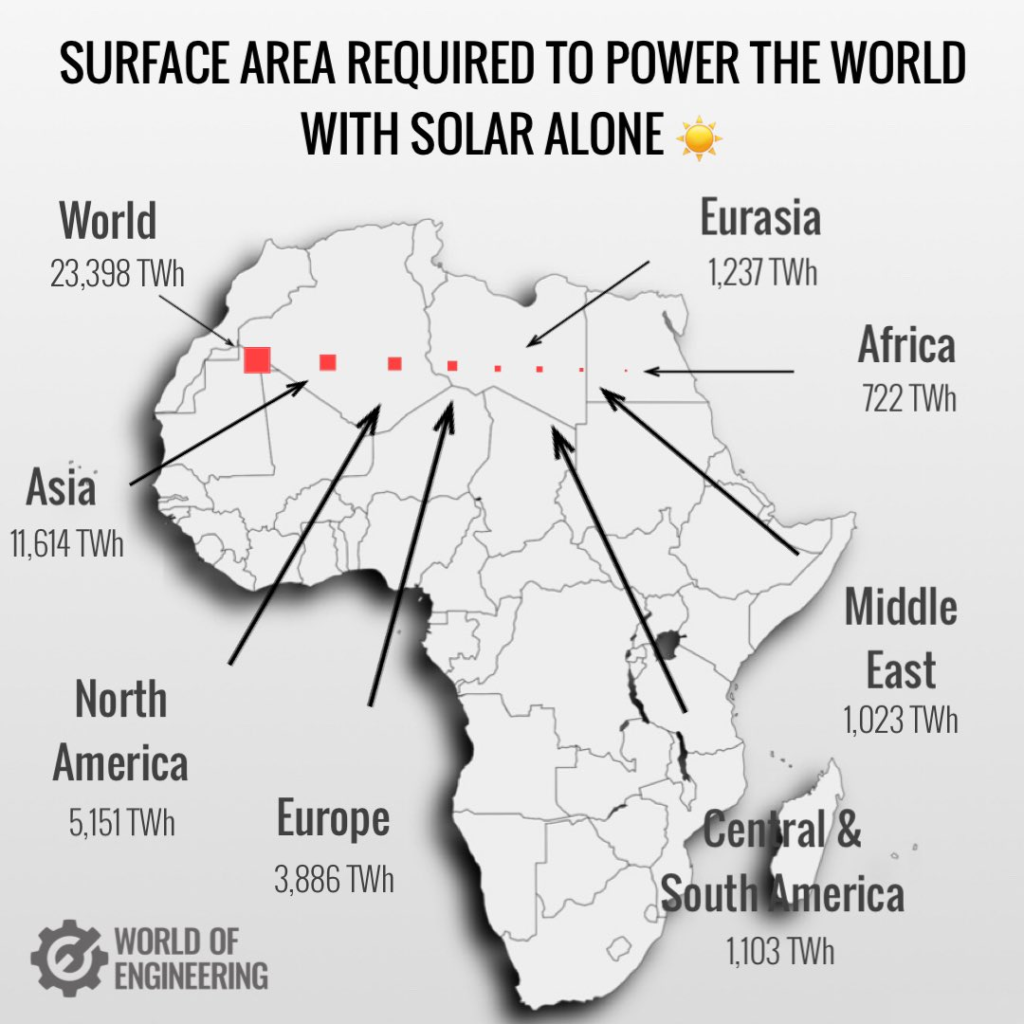
Now, as European energy companies seek to reduce carbon emissions, they are looking to the region for a new source of energy: solar and wind farms that would generate and transport “green” electricity north through undersea cables.
Greece, Italy, Portugal, Spain and even as far away as the United Kingdom are looking for ways to harness renewable energy from the region’s deserts.
Since 1997, Spain’s network has been connected to Morocco by a cable across the Strait of Gibraltar, the only such project in operation today. However, entrepreneurs and utilities across Europe are considering several projects, including extending the Morocco-Spain cable to a 2,000-mile line that runs from Morocco’s Atlantic coast and travels to southern England. This project will be the first of many as the world realizes the enormous benefits of transmitting electricity over long distances.
The submarine cable in Britain
In April, investors in the United Kingdom and the United Arab Emirates committed 30 million pounds ($37.6 million) to the idea, although that is only a fraction of the expected 22 billion pounds cost of solar and wind facilities and the subsea connection (the projects of four other separate cables are already running).
When connected to a giant wind and solar farm planned by Xlinks in the desert of southern Morocco, the system will have enough capacity to power around 7 million homes, helping the UK meet its target of net zero carbon emissions from the sector energy’s. 2035. The length of the path means it will lose about 13% of the power it carries.
The concerns
But it is dangerous to rely on any supplier for energy, as the Xlinks project foresees. In addition, the presence of Russian and Turkish troops in North Africa-Libya, makes the whole effort terrifying given that they can – their representatives but also the troops of these countries – sabotage by interrupting any work in progress.
North Africa may be a great source of energy for Europe, but a single country trading with another is always different from a bloc of 26 countries trading with another.
Although Xlinks will only send power in one direction, others are planning two-way connections, which would allow electricity to flow south when European grids are overloaded and prices fall.
Morocco is to start construction of such a line to Portugal in 2027.
Egypt and Greece are discussing the development of a cable, while at the same time various businessmen are pushing for similar connections from Tunisia and Algeria to Italy. There are significant investments in renewable energy in Portugal and Spain, but if we turn on the taps, believe me, the African kilowatt hour will be very competitive.
The Greek submarine cable
It is recalled that the GREGY electricity interconnection project between Egypt and Greece will bring Egypt and Europe multilateral benefits, strengthening market integration, enhancing security of supply and increasing social and economic prosperity in Greece, EU member states and Egypt. GREGY will enable the supply of 3,000 MW of green energy from Egypt to Greece, thereby supporting the EU to achieve its RES and decarbonisation targets and reduce its dependence on electricity generated from natural gas.
In acceleration and development phase
Also, at the beginning of May, a Memorandum of Understanding was signed between ADMHE and the company ELICA SA of the Kopelouzos Group, regarding the initiation of exclusive discussions for the evaluation of ADMHE’s entry into the share capital of the company developing the electrical interconnection project between Greece and Egypt, GREGY – Green Energy Interconnector. The intention of the Parties is for ADMIE to acquire a percentage of up to 33.3% of the company.
The Parties will seek through their cooperation to utilize their specialization, experience and technical, commercial and financial know-how, for the fastest development and implementation of the project and its more successful management. Within the framework of the Memorandum, it is also foreseen to hold discussions between the two Parties and the Operator of the Electricity Transmission System of Egypt (EETC).
The intention of the Parties is for EETC, ELICA and ADMIE to participate in the share composition with a percentage of 33.3% each. In addition, it is envisaged that ADMIE may proceed, in collaboration with ELICA, with additional studies on internal transport infrastructure projects that may be required to ensure the interconnection of national transport systems with the GREGY project.
Τhe GREGY-Green Energy Interconnector project
The 3 GW GREGY will transport electricity from 9.5 GW wind and solar farms being developed by the Kopelouzou Group in Egypt. The investment exceeds 4.2 billion euros. The following route is 954 km and starts from El Sallum and reaches N. Makri Attica. This route bypasses geopolitically sensitive maritime areas.
On December 15, the Kopelouzou group filed a request to include the project in the 6th list of PCI projects, accompanied by letters of support from the Ministries of Energy of Greece and Bulgaria and the ADMIE.
The GAP project
The GAP project is divided into two parts:
1. The first foresees an underwater double interconnection with a total power of 2 GW that will start from Egypt and end through the EEZ of the two countries in Atherinolakkos, Crete. The distance is only 450 km, the depths great up to 4,500 km.
2. The second part envisages the interconnection of Crete with Attica through an 800 MW submarine cable that will cross the Cyclades and end at Lavrio.
The entire project amounts to 2.8 billion dollars.

