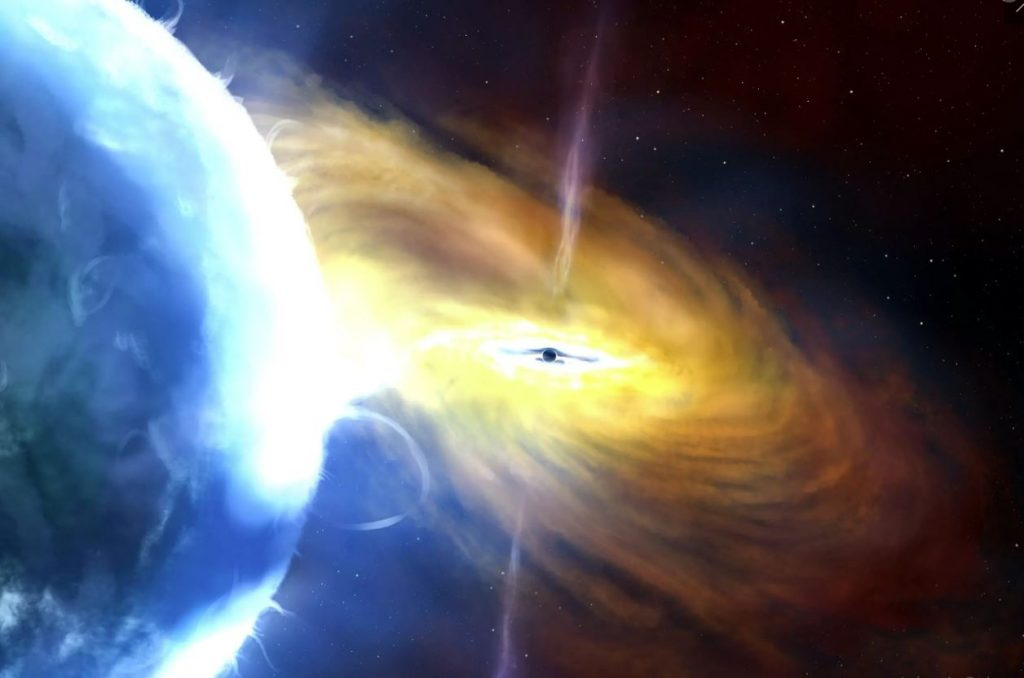
No event has released more energy than the AT2021lwx outburst, which has been ongoing from 2020 to the present. It probably happened when a giant mass of gas had the misfortune to fall into a black hole with a mass of millions or billions of times the mass of the Sun: the result was the most powerful explosion ever recorded in the Universe, ten times brighter than the most powerful known supernova .
The burst, dubbed AT2021lwx, was recorded in 2020 and continues to this day, an international research team reports in the Monthly Notices of the Royal Astronomical Society. In comparison, most supernovae (explosions of aging stars) remain visible for only a few months.
Light from the violent outburst took 8 billion years to reach Earth and be recorded by ground-based telescopes that watch the sky for sudden flashes. Observations with more powerful instruments followed that allowed the energy released to be calculated.
“We found it by chance when it alerted us to the algorithm we were looking for a type of supernova,” team leader Philip Wiseman of the University of Southampton in Britain said in a statement. “It was very unusual for something to be this brilliant for more than two years.”
Blast
Researchers believe the explosion came from a cloud of gas, possibly thousands of times the mass of the Sun, surrounding a supermassive black hole at the center of a distant galaxy.
Some of the gas was trapped by the black hole’s gravitational field and developed extreme temperatures as it swirled around the cosmic monster, before finally falling into it. The shock wave from this plunge spread to the remaining gas and dust surrounding the hole and caused the light to be emitted.
Due to the long duration of the explosion AT2021lwx released a greater amount of energy than any other event recorded so far. Last year, astronomers witnessed the brightest gamma-ray burst ever recorded, an event dubbed GRB 221009A. This flare was brighter than AT2021lwx, but lasted much less and released much less energy.
The researchers used powerful telescopes to examine the spectral signature of the explosion and from there estimate its distance. “Once you know the distance and how bright it appears to us, you can calculate the brightness of the object at its source. When we did the calculations we realized it was extremely bright,” says Professor Sebastian Hennig of the University of Southampton.
Such extreme luminosity is known only from quasars, supermassive black holes at the centers of galaxies that are fueled by a continuous flow of gas and glow continuously, rather than exploding suddenly.
Observations and simulations planned for the near future are expected to reveal new details and confirm or refute the mechanism proposed by the study.
As Dr Wiseman comments, “we hope to record more such events and learn more about them. It is possible that these events, although extremely rare, release such amounts of energy that they are the main processes by which the centers of galaxies change over time.”