



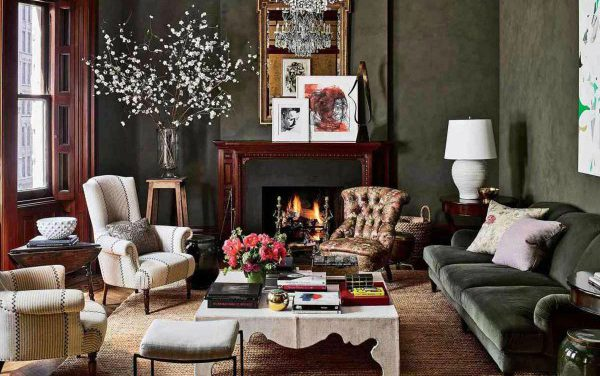
We all come from homes (our parents) and to homes we go (ours). Homes are the best archivers, guardians and expressions of our identity. Once we forget who we were, we have only to open their door, and they will speak for us. Because the houses together with their objects, as unlikely as it may seem, often speak of virtues that we have or that we would like to acquire. The solid woods of the dining room may speak of our integrity, the gilded frames in the bedroom of hedonism, the fluffy sofas of generosity, and the ancient chest of drawers of our love of an older world endowed with the virtue of patience.
Houses make others suspect who we are, tell them about our charm or pride, sometimes even about who we want to be. It is no coincidence that in homes with torn carpets and damp stains, in a cupboard there is always hidden a good cup, a plate with elaborate designs, or a small vase with embroidered buttercups, which whenever its owner looks at it or touches it, he remembers the man he wants to be or the man he is inside.
The great imposing houses often speak to us of acht, even if they remain modestly silent, they speak to us of ambition but also of fear, of the dust and intentions of time that keep their owners awake. As we build our homes we envision the kind of life we want to live in them, and we decorate them accordingly. It is no coincidence that Stendhal said that “there are as many styles of beauty as there are visions of happiness”.
Another finds beauty in a stone house, where he admires the way each stone has matched its neighbors, smoothing bumps and corners for the sake of a common purpose, and another finds beauty in bare concrete, in the virtues it embodies, speed, economy , in his brute force.
What is certain is that both, the one who will choose the stone and the other who will choose the concrete, will do so based on their vision of personal happiness, just as it is also certain that neither the stone nor the concrete , neither wood nor marble will prevent any of them from starting an argument with his wife that will end in threats of divorce. That is precisely where the weakness of objects lies. They may remind us of virtues and standard ideals, but they cannot impose them on us.
Nevertheless, some people, in order to prevent the disappearance of their ideal self or their ideal life, at every failure turn with even greater fury to wallpaper, tiles and paintings. This version may have prompted Oscar Wilde to exclaim “Dress up, so you look more interesting than you really are,” ignoring the pain and frustration behind every unnecessary object.
However, whichever version we choose, what we cannot deny is that objects often work beneficially, and we have only to think of a large home armchair, which provides not only comfortable support but also the feeling of covering our back, as if and to some extent we are still possessed by the ancient fear of being attacked by some predator.
Also, we cannot deny that the abundance of objects often works oppressive and disorienting, and it may not be a coincidence that nowadays houses are more and more bare (minimal aesthetics), as a defense against the feeling that an increasingly more complicated world.
Finally, we cannot deny that the objects that surround us to some extent shape our aesthetics and ethics, nor can we deny that the sudden encounter with an object that has been a companion in the course of our lives, when we happen to see it in a thrift store , in a flea market, can move us more deeply than our encounter with a person from the past, grab us by the sleeve and take us farther than we can bear.
So objects may not have a soul, but they capture or generate feelings and in the end shape us. All of man’s attempts at all styles of decoration, throughout the centuries, from the heavy baroque, the refreshing art nouveau, the latest bohemian or boho style, and the even closer to us minimal have one goal: to talk about the way people think, about the way they see themselves and the world, but also about their morality, because, as the greatest scoundrel of all time, Wilde, very rightly said again: “He is shallow who does not judge by the surface.”
He was also confirmed by Nietzsche, who said that he loves Greek culture, because the Greeks started from the surface to reach the depth. So we stand completely glazed over our surface, in the way we make our houses (no matter how many designers and decorators have intervened), because our houses are sometimes more chatty than any third party who tries to talk about us.


