



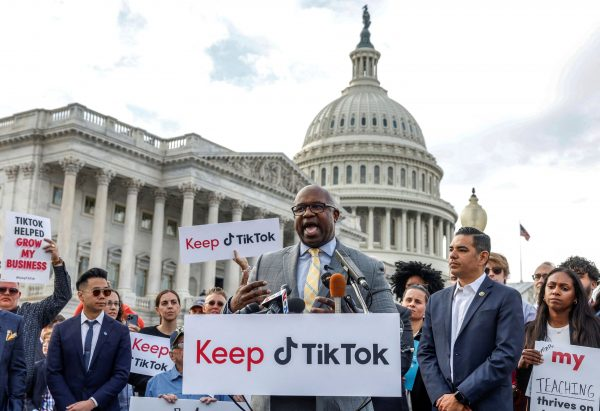
Despite increasingly confrontational rhetoric, the US and China remain deeply economically interdependent. During the appearance of Su Zicheu, CEO of TikTok, before the US Congress, one of the elements that dominated the discussion was that the company that owns the popular social networking application is fully Chinese and therefore controlled by the Chinese government.
This image largely stems from the fact that TikTok’s parent company, ByteDance, was founded by a Chinese entrepreneur, Zhang Yiming.
However, as Chew, who is originally from Singapore, pointed out during his five-hour questioning by members of Congress, 60% of ByteDance is owned by international investors, including several American companies. These include Japan’s SoftBank, US investment firm KKR, US Coatue Management, US General Atlantic, US venture capital firm Sequioa and US-based Susquehanna International Group. The last four also have representatives on the Board of Directors of ByteDance. In addition, large funds such as Black Rock and Fidelity have also invested in ByteDance (please also read the analysis titled “Ukraine, Taiwan and Technological superiority divide the Superpowers“)
Of course, all of this is not to say that there aren’t significant aspects of Chinese control on TikTok. Founder Zhang still holds a stake and his own votes count more than those of other shareholders, while the Chinese government also holds a “golden share” in the company, which gives it veto power and the ability to appoint directors. In addition, there is always the recent Chinese legislation that compels Chinese tech companies to hand over data to the state, while the Chinese state retains control over exports of TikTok’s algorithm.
But that doesn’t negate the fact that even a company now targeted by US (and European) authorities is far more American than its critics care to admit.

The degree of interdependence between China and the US
Although the US strategy is supposed to be to increasingly disengage from China, the world’s two largest economies remain highly interdependent.
For example, bilateral trade between the two countries reached record highs in 2022. The US imported $538.8 billion worth of Chinese goods, slightly below 2018’s record, while US exports to China hit a record high of $153.8 billion.
Accordingly, China, although it has reduced its exposure to US debt, nevertheless still holds a particularly large amount of US debt. At the end of January, China held $859.74 billion worth of US Treasuries, and Beijing is the US Treasury’s second largest creditor.
At the same time the total American investment in China has not decreased, on the contrary it is increasing. In 2021, total US direct investment in China had reached, in historical cost terms, $118.19 billion. Accordingly, again in terms of historical costs, total Chinese investment in the US reached 38.25 billion dollars in 2021.
US investment in Chinese Artificial Intelligence ventures
The US government has given particular weight to the effort to impose sanctions against large Chinese high-tech companies on the grounds that their technology endangers US security if used for military purposes.
It is no coincidence, also, that the American government, in addition to sanctions on Chinese companies, has also taken measures to block China from access to certain technologies, with a more typical example being those required for the production of sophisticated very thin microchips, resulting in China needing to cover the distance that separates it from e.g. the Taiwanese companies that today produce the most sophisticated microchips.
However, at the same time, it is striking the extent to which American companies have not only invested in China, but also the fact that they have particularly invested in Chinese Artificial Intelligence companies, the very industry that the US government supposedly sees as a threat to the US. security.
A recent survey showed that between 2015 and 2021, 167 US investors participated in 401 investment transactions in Chinese AI companies, representing 17% of the total number of related transactions.
Investment deals involving Chinese AI companies involving US investors totaled $40.2 billion, or 37% of the $110 billion in total capital raised by Chinese AI companies. Of course, it is not necessary that all 40 billion came from American investors.
The basic form that American investments have are those of venture capital practices and in fact at a rate of 91%, a fact that shows, among all others, that American investors play a decisive role in the first and presumably most critical steps of Chinese artificial intelligence companies.
The difficulty of disconnecting
All of this shows that while relations between the US and China are deteriorating, as Washington increasingly views Beijing as a competitor and a potentially hostile power, the real economic relationship between the two countries remains highly developed and very difficult to advance the so-called “disconnection”.


