


Who would have thought that in the age of fifth-generation fighter jets and spy satellites, there would be a buzz about a… hot air balloon. However, at the current stage of US relations with China, even that can happen.
First of all, balloons can indeed be used for espionage purposes. They go higher than ordinary spy planes, can stay in flight for a long time and collect information. Unmanned aerial vehicles may now be considered the standard means of surveillance and intelligence gathering, but several countries are also considering the use of balloons.
Anyway, balloons have been used for research purposes for years by meteorologists because it was a practical way to gather information about the upper layers of the atmosphere.
And indeed the spot where the Chinese balloon was spotted, that is over the State of Montana which, above all else, has one of the largest bases with intercontinental missiles Minuteman III (the land side of the US nuclear triangle with the other two being the nuclear-tipped missile submarines and nuclear-capable strategic bombers), seems like an area that would warrant an intelligence-gathering effort.
However, at the same time it is interesting that China immediately rushed to “give explanations” in low tones, claiming that the balloon was scientific and not spying and was simply carried away by weather phenomena and that it did not intend to violate territorial integrity. and the sovereignty of the USA and as what happened was the result of force majeure.
Why did the US react so strongly?
The United States chose not to accept the explanations provided by the Chinese Foreign Ministry and proceed with a kind of retaliation, postponing Blinken’s visit to Beijing.
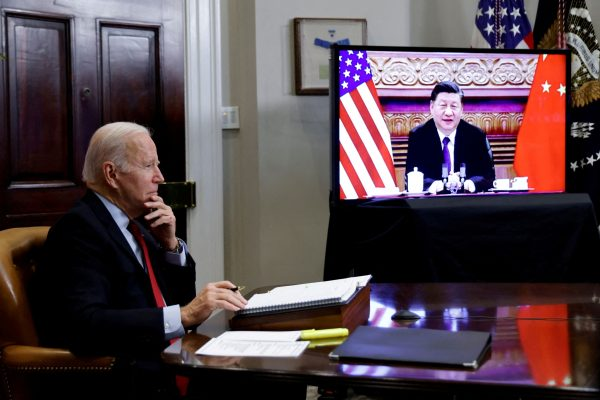
And this despite the fact that this opening of channels of communication and avoidance of tensions was discussed during the meeting of Joe Biden with Xi Jinping last November on the sidelines on the sidelines of the G20 in Bali.
This fact shows that the USA in particular has shifted to a rather confrontational position. This is also seen in other moves, such as the export bans to China of technologies that can be used to produce the latest generation of chips, or the decision to strengthen the military presence in the Philippines as a counterweight to China’s effort to gain better relations with Philippine government. And of course, it was preceded by Nancy Pelosi’s visit to Taiwan, a move that Beijing saw as purely hostile and as US intervention in a particularly charged issue, namely the reunification of China. In fact, it is no coincidence that Pelosi’s successor, Republican Kevin McCarthy, is also reportedly considering visiting Taiwan, even though Pelosi’s visit had led to US-China tension and an impressive display of military power by China against Taiwan.

The US swing
In fact the US is in a vacillation between its strategic horizon and its tactical options. On the horizon they see China as the great rival, as the power that can challenge their own primacy and hegemony. China is a large country, the world’s second economy, it has started a process of equipping itself to acquire superpower characteristics and of course it is trying to cover the technological distance that separates it from the USA. This objectively pushes the US into an ongoing political and economic confrontation in several ways: From trying to block China from critical technologies, an indirect form of trade-economic warfare despite the invocation of security reasons, to the way the Uyghur issue comes back together with an attempt to stop Chinese investment in Western countries.
At the same time the degree of interdependence of the Chinese and US economies, the way China is extremely important in critical supply chains for which the US has not been able to have alternatives, but also the very weight of China in the dynamics of the world economy makes the rupture more difficult.
On the other hand, even though the USA has an open front with Russia, which on its horizon is also a front against a Eurasian convergence of Russia and China, it cannot easily have an open front with China.
If one adds the fact that the US is heading into a pre-election period where the Democratic administration does not want to appear “dominant” we can understand why we will see several American swings towards both tightening and easing, with the biggest tightening remaining basic horizon.
For its part, the Chinese leadership appears to want at this stage to avoid an escalation of the conflict – it wants to complete medium-term planning for China itself anyway – hence the avoidance of high tones and the insistence that stable and cooperative relations with the US, but at the same time it is clear that it is also preparing for a period of greater tensions.