The conversion of the German government and Olaf Scholz himself in relation to sending tanks to Ukraine signals a more comprehensive decision by the “Western alliance” to escalate military operations in Ukraine.
It is no coincidence that in order for the German conversion to take place, which will involve a first relatively small shipment of Leopard 2 tanks from the stocks of the German army itself and mainly Germany’s license to other countries that have such German-made tanks in their possession to send them to Ukraine from their own stockpiles, it first took the US announcement that they are also changing positions and will now also send M1 Abrams tanks (please also read the analysis titled “Why does Ukraine ask for heavy armoured battle tanks and the dilemmas of the West?“).
The tanks have been something that Kyiv has been insisting on, as it considers such heavy tanks necessary to enable the Ukrainian armed forces to mount major counter-attacks and break through Russian lines.

Scaling up to what point
Essentially, the tanks signal the choice to have a new escalation of the military confrontation in Ukraine. And this is because they refer to a new large concentration of forces on the Ukrainian side, which will try to force the Russian forces, if not to retreat, at least to an even greater involvement, thus greater losses, greater financial costs and finally greater delegitimization.
Although the Ukrainian side insists that with the appropriate additional weaponry it could overturn the overall balance of power and liberate a significant part of the territories now under Russian occupation (and formally incorporated into Russian territory, after all), the reality is that this is quite difficult, based on the way things have turned out.
Russian partial mobilization has strengthened Russian positions, Russia’s ongoing war of attrition means ever greater costs to Ukrainian infrastructure, Russia is making small advances in the Donbass, while Russia shows no shortage of equipment. Of course, Ukraine has greater numerical strength, which has so far meant greater resistance to increased casualties, but this does not mean an unlimited ability to send forces into high-casualty operations.
This means that the escalation that Ukraine is currently seeking, and that NATO is clearly preparing to support by sending equipment and heavy tanks, will hardly lead to what is supposed to be its stated goal, namely a defeat of Russia that will lead to its rapid withdrawal from important areas under its control. It is more correct to say that the purpose of the escalation is to significantly increase the cost of the war operation for the Russian side, a greater Russian “bleed”.
And of course there is the open question of whether there will be a Russian escalation. So far Russia has opted for a gradual escalation that in some cases has included the horizon of a political negotiation. To the extent that it is now clear that for a significant period of time there will be no real negotiation of a ceasefire and a peace process, as neither Ukraine nor NATO can at this stage accept the “accomplished” on the battlefield, Russia is likely to escalate its military involvement as well.

War without end?
The involvement of NATO and especially the USA has a significant escalation during the war. We recall that at various times US representatives stated that they would only provide defensive weapons, although at successive times the type of defense assistance was escalated. So for example from the initial declarations of “limited assistance”, we have moved to sending HIMARS arrays and heavy artillery, to increasing participation in the training of the Ukrainian armed forces, to intelligence support and now to sending heavy tanks.
However, the greater the involvement of the US and NATO, the greater the difficulty to disengage from the war conflict. In reality, what is seen is an outline of ever greater military involvement, the deployment of ever more resources and equipment, and an ever-shrinking distance between strengthening the Ukrainian side and “direct” confrontation with Russia.
And the problem is that as the entanglement escalates, it becomes more difficult to disengage. To put it more simply: the more NATO contributes to the strengthening of the Ukrainian counterattack, e.g. with the dispatch of heavy tanks, the more difficult it is when these reinforcements fail to have their express objective, namely the defeat of Russia, to disengage. On the contrary, it will seem like an inevitable choice, the even greater involvement, thus the sending of even more armaments and more aggressive weapon systems.
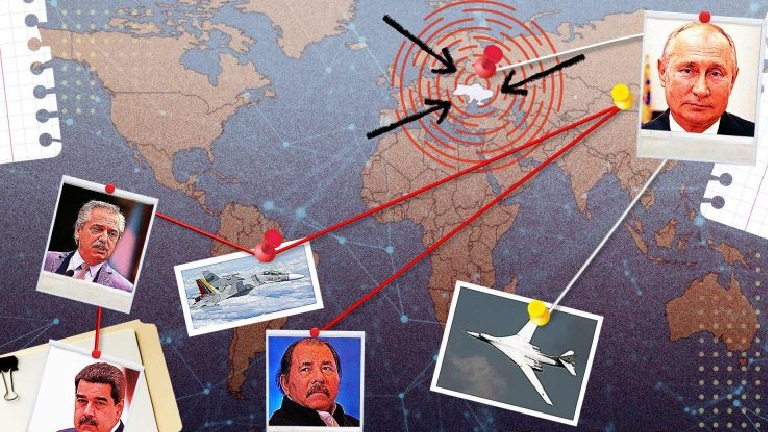
Except that at the same time it will bring closer the possibility of NATO crossing the last red line which is the direct participation of NATO forces in the war operation, one way or another. But then we go to a kind of heated confrontation between Russia and NATO that can only have unpredictable consequences, if we consider that it is a confrontation with a nuclear horizon.