



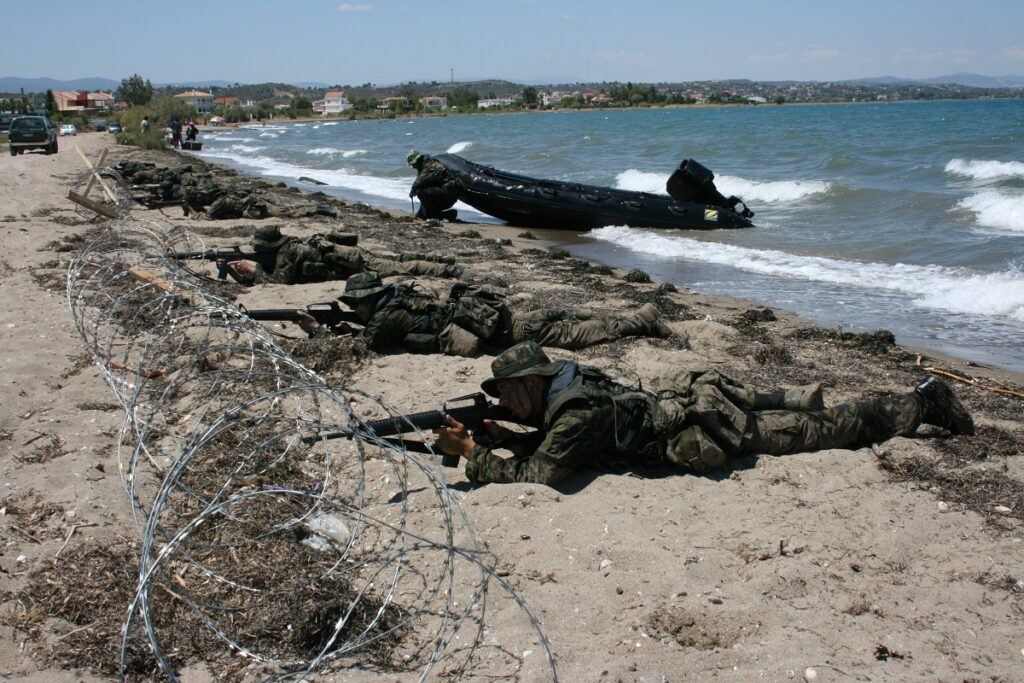
The US/NATO turn to Great Power competition/conflict, with the ongoing war in Ukraine as the main example, offers NATO countries and not only lessons, for the more effective use of Special Operations Forces/Special Forces which are very closer to the national defense needs of their countries, in contrast to the lessons learned so far from the twenty-year war on Terror.
The war in Ukraine provided an example of how Special Operations Forces (SOF) and Special Forces in general can be a central axis and/or a critical power multiplier of a conventional national defense. At the same time, the US armed forces are now asking the Special Operations Command (USSOCOM) to propose an operational action plan for the SOFs it controls, with which it will contribute as a command as a whole to the new doctrine of the Integrated Interbranch War (Joint Warfighter Concept ) against conventional threats from technologically equivalent and/or quantitatively superior Great Powers.
If USSOCOM’s proposed plan does not “convince” the Joint Chiefs of Staff, there is a risk that the command will lose the unofficial but essential “Branch” characteristics it acquired thanks to the War on Terrorism, and return to an organization that deals not with business, but with matters of equipment, training, doctrine and administrative management. If this eventually happens, the SOFs of each Branch will come under closer or even near total operational control of their Branches, to serve as part of this now broader doctrine of Interbranch War. The geographic Commanders/Combatant Commands of the US armed forces will gain greater or even complete control over the planning of operations and the determination of the missions of the SOFs, at the expense of the individual Special Operations Commands within each Combatant Command.

The Special Forces of Ukraine in action
Ukraine used its SOF and Select Forces (could be called Special Forces) to counter a conventional military in a large-scale/high-intensity/long-duration conflict.
Ukrainian SOF were numerous (estimated at 4,000 to 6,000 members) as were Elite Units (Azov Group estimated at 16,000 to 22,000 men). It took eight years and a huge contribution from NATO SOF in both trainers/advisors and funding and infrastructure to achieve this goal. This allowed the massive and wide frontal use of SOF/Special Forces against the armored/motorized forces of the Russian army.
The impact of the action of the Ukrainian SOF/Special Forces against the Russian motorized forces was made possible on the one hand by equipping them with high-tech anti-tank systems provided by NATO in huge quantities, and on the other hand by the strategic choice of entrenching the Ukrainian army in permanent fortifications and in urban centers, where the civilian population had not been evacuated, so that it could be “tooled” and thus play an important operational and psychological role.
The main missions of the Ukrainian SOF/Special Forces were: the execution of anti-tank ambushes in an urban/semi-urban environment, the execution of raids on the flanks and rear of the Russian units, the qualitative and moral reinforcement of the conventional ground forces, the “support” of psychological operations to serve the strategic purposes of the US/NATO/Kiev government. Russian maneuver warfare by powerful but small Tactical Battalion Groups, which had limited territorial control areas, left many gaps for Ukrainian SOF to infiltrate with wheeled armored vehicles to conduct ambushes and raids. Almost 100% of Ukrainian Special Operations involved ground operations, on the one hand due to the fluid nature of the battlefield and on the other hand due to Russian air dominance with aircraft and/or anti-aircraft systems. For example, an airborne operation by the Ukrainian SOF in Fidonisi ended in utter tragedy.

The Reconnaissance mission by Ukrainian SOF at the tactical/operational level is not known to be successful, as strikes on Russian artillery HQs and artillery positions were achieved primarily by Unmanned Aerial Vehicles (UAVs) and NATO air and satellite observation/intelligence means. . However, it is fair to assume that the fluidity of the battlefield allowed for the installation of hidden observatories/hideouts of small reconnaissance groups in the Russian rear, which located and transmitted coordinates of important targets in near real time.
These ways of using Ukrainian SOF/Special Forces against a strong conventional opponent on a conventional battlefield had the inevitable consequence of heavy casualties. The Russians made extensive use of their own Special Forces (Spetsnaz) to scout and clear the ground in front of the Armored Brigades. These Russian Special Forces Hunter-Killer Teams infiltrated the area of operations before the Armored Brigades entered it, and with the help of Russian militiamen and agents who knew the terrain, tracked down the Ukrainians and eliminated them (a large role was played by numerous sniper teams/ detectors).
On the other hand, Ukrainian SOF/Special Forces ambushes and raids day and night (whether successful or not) brought the Russian mechanized forces to respond with heavy machine guns, fast APCs, automatic grenade launchers, mortars and artillery, guided by modern thermal sensors, resulting in immediate heavy losses to ambushers and raiders. The heavy losses have dramatically “drained” the Ukrainian SOF/Special Forces, which cannot replace them as an Operator needs at least two to three years to become “operational”.
Lessons learned from the action of Ukrainian SOF
The main lessons learned from the action of the Ukrainian SOF/Special Forces can be summarized as follows:
1. Strategic Impact of SOF in a large-scale/intensity/duration land war exists when Quantity meets Quality, since SOF will have to cover an entire theater of operations, integrate with conventional units, and “absorb” casualties.
2. A Geographically Wide and Fluid (Land in Ukraine) battlefield is a necessary condition to enable a sustainable SOF operation. Gaps between mechanized units conducting mobile warfare allow SOF units to infiltrate. The nature of the terrain also facilitates SOF action. Ukraine’s large and dense forests, as well as the urban and peri-urban fabric on which combat operations are focused, have allowed Ukrainian SOF to infiltrate, hide, and live within enemy territory.
3. Portable high technology in the field of C5IR (Command, Control, Communications, Computer, Cyber, and Intelligence Resource) that ensures Cognitive Dominance, and “smart” portable weapon systems of high effectiveness against “hard targets” (Hard Target Attack) in SOF is essential to counter the high technology of conventional forces and their superiority in quantity, protection and firepower. Ukrainian SOF were equipped with high-tech NATO communications/data transmission devices, which operated through US/NATO infrastructure in this sector (satellites, and C5I aircraft).
4. The SOF Penetration/Transportation-Striking Means must be proportional to the geographical space of the theater of operations, the type of war, and the capabilities of the adversary, factors that determine the methods/tactics of action of the SOF. Ukrainian SOF invested in Special Operations Armored Fighting Vehicles / Armored Personnel Carriers because: aerial action (infiltration/withdrawal) would be impossible due to Russian air dominance, theater of operations was mostly land, geography (large plains with forests and urban centers) favored wheeled vehicle movement, and the fluid, control-gap, ground battlefield favored land penetration.
5. The “Consumption” of SOF in conventional warfare is high and results in their rapid “Degradation”. SOF strikes (in mass or selective form) against conventional modern armies cause them heavy losses, which are not immediately or in the medium term irreplaceable due to the long period of training/certification of SOF Operators. Therefore, from a strategic/operational point of view, SOF constitute a strategic weapon in a conventional conflict, yielding significant results mainly at the beginning of the conflict, and for a period of time proportional to their quantity and/or their reserve.

Epilogue
The main conclusion from the use of Ukrainian SOF is that thanks to C5I technology and “smart” man-portable missiles of high efficiency, Special Forces can now have a critical strategic effect even as support to conventional forces in the context of high-intensity/long-duration conventional warfare. This does not mean that SOF will reject independent action to achieve strategic objectives, and be supported by conventional forces in doing so.

