Tehran is increasingly worried about Azerbaijan’s independence. at the same time it should not escape us that Azerbaijan also has historical ties with Iran. It was for a long time part of successive Iranian empires, culturally even today it has many Iranian elements and of course a significant number of Azeris live in today’s Iran, where they are the largest minority (18-25%)
Recently, there has been a stronger nationalism on the part of Azerbaijan and the claim of a more upgraded position in the wider region. This was also seen in the recent cycle of armed confrontation with Armenia and the claim to modify the relationship that had been formed in the conflicts until the early 1990s.
Azerbaijan has traditionally followed a rather cautious policy, avoiding major confrontations with countries such as Iran. This also contributed to the way that Russia, which maintains good relations with Azerbaijan, wanted things in its wider “neighborhood”, especially in areas that were part of the former USSR, not to deviate from a framework of balance.
But after the 2020 clash with Armenia where Azerbaijan was listed as the clearly stronger power, there is a sense that he would like to tweak the border even further.

The role of Turkey
On the other hand, for Turkey, especially during the Erdogan era, with its ambitions to emerge as an important regional power and investing in a more interventionist role in the wider region towards Central Asia, Azerbaijan with its close linguistic ties to Turkey was from the beginning an a particularly critical hub, especially since Ankara has also invested heavily in the cooperation of the Turkic peoples.
Of course, at the same time, Turkey has tried to maintain good relations with Iran, especially since the two countries cooperate in the Astana process to manage the Syrian crisis, in which they share a common rejection of the possibility creation of a Kurdish state entity.
For its part, Ankara has invested particularly in the effort to further upgrade the Organization of Turkic States, which includes Azerbaijan, Kazakhstan, Kyrgyzstan, Turkey and Uzbekistan. It is in a way its great opening to the wider region of Central Asia, while at the same time it gives a wider dimension to Turkish nationalism and is consistent with the overall assertion of a role as an emerging regional power that can represent a set of nations and states.
But this is increasingly seen as a threat by Iran, which it believes could destabilize the situation in the north, especially since the strong Turkic minorities are concentrated there. Iran fears that Turkish support for Azerbaijan is fueling its redemptive tendencies. After all, Iranians were furious with Erdogan, who, visiting Baku in December 2020 to celebrate Azerbaijan’s victory over Armenia, recited a poem lamenting the “division” of Azerbaijan, which was seen as a legitimization of Azerbaijani independence.
The Escalation of Tension – Zangezur Corridor
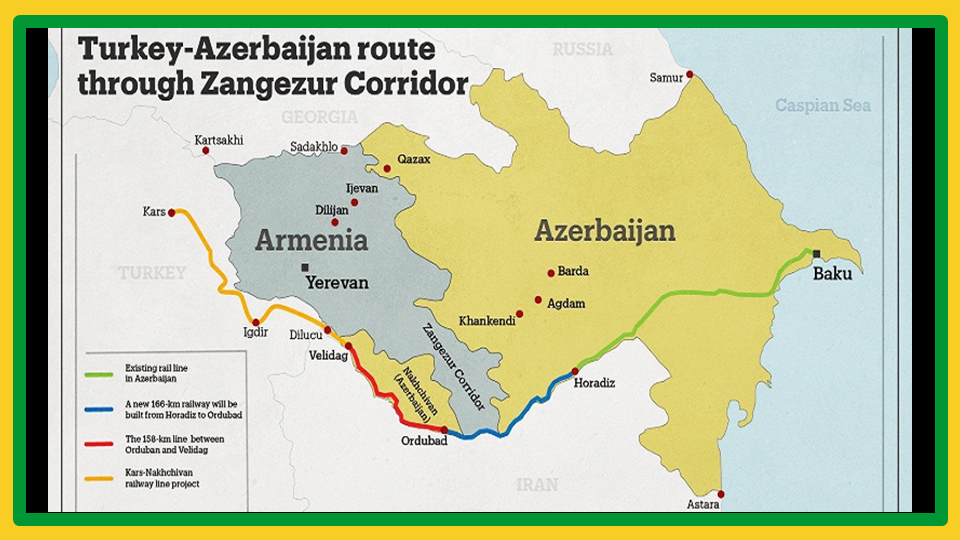
The current tension centers on exactly what will happen to the Zangezur Corridor. This is a transport link that will ensure communication between Azerbaijan and the enclave of Nakhchivan which is within the geographical boundaries of Armenia and borders Iran and Turkey.
The corridor is supposed to be part of the tripartite agreement between Russia, Armenia and Azerbaijan, which led to a ceasefire in the 2020 conflict. But Armenia disputes the concept of a “corridor”, which would imply Azeri sovereignty over territory in the south, arguing that a rail connection is sufficient.

The fear is that Azerbaijan, which also enjoys Turkey’s military support, will at some point try to impose this “corridor” even armed.
Now a corridor connecting Nakhchivan directly with Azerbaijan would be of particular interest to Turkey, which borders Nakhchivan and could thus gain direct access to Central Asia through Azerbaijan, effectively bypassing Iran. In addition, Iran fears that an Azerbaijani-controlled corridor in the south of Armenia would undermine Iran’s access to Armenia and upset the current balance.
Tehran made sure to make its displeasure even clearer by organizing military exercises on its border with Azerbaijan, including exercises to cross the Aras River (Araxi), which is a natural border between the two countries. In addition, Iran opened a consulate in the southern Armenian province of Shunik, through which the corridor proposed by the Azeris would pass.
Redemption rhetoric for “Greater Azerbaijan”
At the same time, Azerbaijan has begun to adopt a redemptive rhetoric towards Iran. Speaking on November 11 at the Organization of Turkish States, President Aliyev argued that the rights and safety of the millions of Azeris who “unfortunately live outside the borders of Azerbaijan” need to be protected, a direct reference to the large Azeri minority in Iran.
At the same time, in the Azerbaijani media, references to a “united Azerbaijan” are heard again, but the northern provinces of Iran are also described as “South Azerbaijan”, since the Azeri minority lives there. And this despite the fact that Azerbaijan had supposedly stopped this rhetoric referring to the brief period of its president, the pro-Turkish and anti-Iranian Abulfaz Elchibey, who was ousted by Heydar Aliyev who will rule until 2003 to be succeeded by his son.

Accordingly, Mahmundali Chehreghani, the leader of the National Awakening Movement of South Azerbaijan, which supports the secession of these provinces from Iran and who was for years a persona non grata in Baku, now appears on Azerbaijan’s state television and talks about the need to a “Greater Azerbaijan” was created.
Iran, for its part, has claimed that it was an Azeri from Baku who coordinated the attack on a Shiite mosque in Iran on October 26 that killed 15 people. In retaliation, Azerbaijan arrested 19 people in early November, accusing them of spying for Iran and planning actions against state security.
At the same time, Azerbaijan further provoked Iran by announcing that it is opening an embassy in Tel Aviv, continuing its growing defense cooperation with Israel.