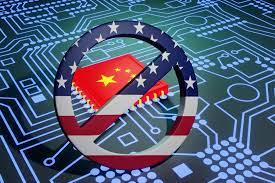
The US-China conflict is intensifying, in the economic field, given the decision of the US to ban the export of advanced semiconductors (chips) to China. This policy is essentially full-scale economic warfare. These materials are used in almost the entire range of product production and service provision internationally. Semiconductors are the basis for technological superiority, which is now the cornerstone not only of the economy, but also of defense.
Last August, US President Joe Biden signed a special executive order with incentives to boost the semiconductor industry as well as repatriate production to the US.
The blow is made all the more painful because it comes at a time when the Chinese development model is being tested. China’s economic growth rates, which it achieved in previous decades thanks to low labor costs and inflows of foreign investment, are slowing.
Americans are now consciously promoting the “disengagement” of the US from China. Xi Jinping’s assumption of power for a third term last weekend and the “purging” of top party leadership positions of potential dissidents was seen in Washington as another sign that China is no longer a hotbed of investment.
This signal was also received by investors who proceeded to sell off Chinese securities, as a result of which the Hang Seng index of the Hong Kong Stock Exchange lost 7% on the day after the 2nd congress of the Communist Party of China that renewed the term of Xi Jinping, while the An index of shares of Chinese companies traded on the New York Stock Exchange lost 14%. The Chinese currency has lost 13% of its value against the dollar since the beginning of the year.
The Chinese economy is in a critical phase. Beijing has long made it a strategic goal to shift the center of gravity of economic growth. from exports and foreign investment, within the country and domestic consumption. However, this goal has not been achieved and is becoming even more difficult due to the rapid acceleration of the “disconnection” between China and the West which the USA is now openly promoting.
China is a strategic adversary of the US, a situation that simulates the situation where an established power rushes to clash with a rising one to prevent it from gaining primacy.
US Secretary of State Anthony Blinken made it clear in a speech last May: “China is the only country that has the intention to change the international order and is increasingly acquiring the economic, diplomatic, military and technological capability to do so. ».
Western, mainly American, think tanks have been constantly channeling analyzes recently that converge to the conclusion that the doctrine of China’s integration into world trade has failed, as economic development in the Land of the Dragon has not been accompanied by a change in institutions and Western-style democratization. The immediate conclusion of these analyzes is that China is no longer the best place for American investment.
The embargo for advanced semiconductors is expected to work multiplyingly in this direction. And this is not only for American products, but also for European companies, which will have to ensure that their exports to China do not contain American banned chips.
Beijing has a declared strategic goal to develop its own semiconductor manufacturing technology and infrastructure, and is estimated to have been building up stockpiles in recent years. But the case will not be easy because the West holds important “keys” to the international supply chain.
The design is done primarily by American companies, while a significant part of the production equipment is manufactured in Europe. The largest production plants are located in Taiwan, but also in South Korea.