



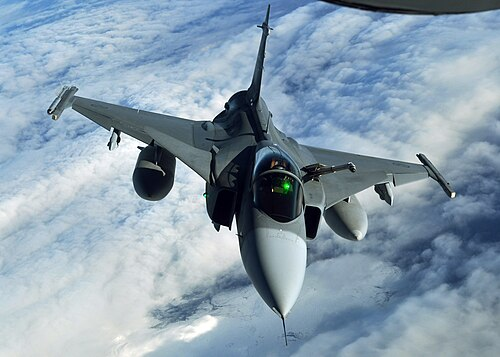
The Royal United Services Institute (RUSI) has called on international policy-makers to consider supplying the Ukrainian Air Force with Saab JAS 39 Gripen C/D fighter jets.
The UK-based Royal United Services Institute (RUSI) reported in a report (https://rusi.org/news-and-comment/in-the-news/ukraine-receives-air-defence-systems-russia -continues-air-strikes), that after considering Russian air warfare and Ukrainian air defense requirements, the Swedish aircraft was “by far the most suitable candidate” for a Western-built fighter, as the jets in question could meet operational needs.
The transfer of the Gripens will advance Ukrainian short- to medium-term planning by minimizing the risk of retaining Russian long-range missiles,” the report said.
The Royal United Services Institute (RUSI) also warned that the delivery of the aircraft, along with SAM launchers, missile munitions and self-propelled anti-aircraft guns, are all critical to preventing a new Russian strike campaign, which, if not challenged, could lead to a dramatic change in the current “momentum” of the war.
The Swedish Air Force has always emphasized low-level air superiority tactics from dispersed bases, similar to how the Ukrainian Air Force operates today, and so the Gripen was designed with ground support equipment and maintenance requirements compatible with this approach.” the report said. “The electronic warfare suite on the Gripen C/D is also optimized specifically to counter Russian SAM fighters and radars,” he added.
In addition, the report states that the Gripen’s anti-ship capability and air-to-air missile (BVRAAM) integration, in addition to the MBDA visual range and ramjet propulsion design, are less affected by adversary threats, compared to rocket-propelled weapons .
Air-launched weapons based on missile technology are widely considered to be more vulnerable to ground-based threats due to their “low and slow” capabilities.
“Since April, VKS (Russian Air Force) pilots have been extremely reluctant to fight aggressively in Ukrainian airspace, due to the losses incurred during the first attempts,” RUSI authors note. The threat of Ukrainian SAM and MANPADS engagements has shaped the behavior and significantly limited the effectiveness of Russian pilots.
“Therefore, even some modern (other) Western long-range missile fighters capable of dealing with the Russians on technically equal or even superior terms would likely have a disproportionate deterrent effect,” the report said.
Despite the analysis reopening the debate over whether or not European or American receivers should approve sending Western-made fighter jets to Ukraine, tensions around the issue, often linked to fears of an escalation of the conflict, , permits to fly from NATO territory, and training difficulties, continue to hold back the deployment of fighter jets.
However, if the Gripen C/D variant were approved for transfer, the current European operators, Sweden, Hungary and the Czech Republic, would all be willing to perform deliveries to Ukraine.
“The (RUSI) report identified many of Gripen’s outstanding qualities, which make it a suitable fighter candidate for a country’s defense,” said a Saab spokesman. “Finally the export of the Gripen, including to Ukraine, is strictly regulated and needs approvals from the relevant authorities. Therefore, any such decision will be up to them and therefore it is better to raise further questions with them about the feasibility,” it said.
Previous requests by Ukrainian President Volodymyr Zelensky to NATO members for Western fighter jets have been rejected even as some US officials, including Air Force Chief of Staff Gen. Charles Q. Brown, have publicly supported the idea.
In March, Bulgaria, Poland and Slovakia – the only European countries that can supply aircraft shared with Ukraine’s MiG-29 and Su-25 fighter fleets – blocked all such transfers, after previously suggesting otherwise. At the time, the Pentagon said that the transfer of Polish aircraft to Ukraine, specifically, via US bases in Germany was “prohibited”.


