




The importance of information for the successful conduct of business has been assessed as critical since ancient times. It is no coincidence that Alexander the Great, during his campaign in Persia, surrounded his army (the Macedonian Phalanx) from a multitude of non-combat specialties, such as surveyors, engineers, etc. There are three main pillars that are of interest in military operations, Weather – Enemy – Terrain, while according to Sun Tzu, information should also be sought about our own forces.
But it is important to separate the concept of data from the concept of information. Data are numbers, letters, digits, etc., which, if not analyzed in the light of some context, have no meaning or practical significance. So the processing of the data and its conceptual performance is the one that has value and yields exploitable products.
Although technology has the ability to process (and subsequently store, transfer, etc.) this vast amount of data, the final judgment remains with the decision makers. This may no longer be so easy, and the associated challenges are collectively described as Information Overload.
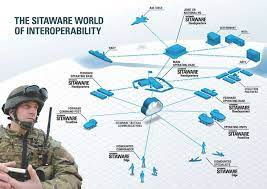
The Key word: Interoperability
Today’s field of operations is characterized by non-linearity, chaotic developments, multi-splitting and multi-dimensionality (now a modern field of operations will extend from the depths of the oceans to space while also expanding into cyberspace). Modern Armed Forces must be ready to operate in such a multi-factorial environment.
To achieve this they will have to begin (if they have not already done so) to break down the barriers that exist between the various branches and services, to review the current doctrines and to create those appropriate infrastructures, which will allow for immediate and valid processing of that huge amount of data collected by millions of sensors. It should be understood that the impossibility of processing means in practice the cancellation of all the investments that have been made to acquire sensors of various types, be they radars, or optical observation systems, etc. The key word in the whole effort is Interoperability.
The term interoperability has a double meaning. On the one hand, it refers to the purely technical part, and to the ability of communication and other electronic and electrical means to exchange, not only information but also services, both among themselves and with the operators/end users. On the other hand, however, it refers to the ability of the various branches of the armed forces to operate and operate in a coherent, effective and efficient manner regardless of the level of command to achieve the objectives at each level (tactical, operational, strategic).
Achieving the second goal of interoperability is about changing mindsets and is achieved from the bottom up, by bringing the gunner to the helicopter operator, the sailor to the Marine, and the weapons operator to the aircraft operator. As a senior officer had said to the undersigned many years ago, “a good anti-airman should be a bit of an airman.” The undersigned believes that this phrase is the pinnacle of interoperability between disciplines.
Regarding the technical part, modern technology has allowed the closing of the gap between the collection of the data and its processing and presentation. A typical example of the technology’s capabilities is the suite of computing systems carried by the F-35 Lighting II fighter. Although as an aviation and stealth platform the F-35 has received a lot of criticism, its ability to collect a huge amount of data from multiple sensors (e.g. AESA radar, EO/DAS, and EOTS), their processing and presenting them in a coherent and completely comprehensible way to the operator is an undeniable and critical factor of excellence.
The Integrated Air and Missile Defence (IAMD)
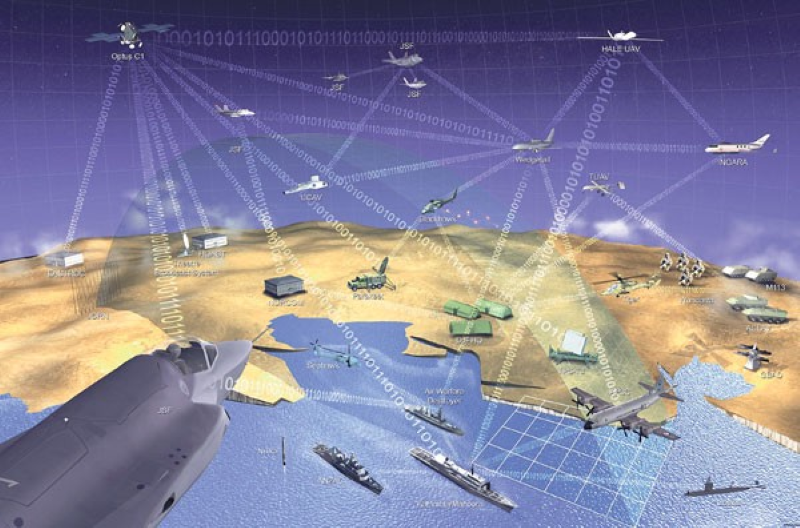
One area that presents the greatest challenges in terms of collecting, processing, and managing a huge amount of information is that of Integrated Air and Missile Defense (IAMD). It is no coincidence that NATO considers this particular mission to be of critical importance, whether in peace, crisis or war, as it provides the required “control” of the airspace, allowing friendly forces to carry out their full range of missions. The NATINAMDS – NATO Integrated Air and Missile Defense System implements NATO policy in practice. As a system it consists of a huge network of interconnected national and NATO systems, whether these are sensors, command and control assets, or weapon systems.

As can be seen from the image above, an integrated air defense system consists of a large number of different types of sensors, which can be located at extremely long distances from each other. Although the figure already looks complicated, the reality is much worse, as the A/Fs, satellites, optical sensors, etc., are not even shown in the figure, which shows only one part of the IAMD mission that of the Ballistic Missile Defense.
An integrated and interoperable system of systems (system of systems) should therefore be able to integrate systems of various “generations” (thus capabilities, volume of information created, etc.), from different manufacturers (usually there is more than one solution for each problem ), which may be on different platforms. For example a given communications infrastructure has a different degree of difficulty if the sensor is located on land or at sea.
Additionally, the capabilities of different systems can create other challenges. For example a long range early warning radar has a refresh rate that can range from several seconds to one to two minutes. On the other hand modern phased array radars or weapon system radars have refresh rates of 1~2 seconds (or less). A system that should track one track will actually get two (or more) data, resulting in “false targets”!
One of the ways to enable the interconnection and interoperability of all these systems is through the integration of tactical networks or Tactical Data Links (TDLs). It should be noted here that TDLs refer to a communication standard/protocol (such as Ethernet) and not to any specific system. In this way TDLs can be developed in such a way that they face specific challenges, and satisfy specific requirements.
For example, Link11 refers to broadcast communication in the HF and UHF RF bands, which is usually used by ships, while Link11B refers to a Point-to-Point protocol, which is used by ground-based air defense systems (GBAD) using ground communications networks (for example fiber optic networks). Modern versions, such as Link16 and Link22, are for secure, digital, wireless networks. Different TDLs can be integrated into Multi-TDL networks to allow communication between different systems.
The creation, development and spread of the internet gave a new impetus to the possibility of interconnection and interoperability of different systems. It should be noted that the internet and the word wide web are two completely different concepts and entities. If we would like to present them like a desktop computer, we would say – extremely simplistically – that the internet is the hardware, while the word wide web is the software. Usually, the term internet is used – abusively – for both entities.
The combination of the internet and modern technology laid the foundations for the 4th Industrial Revolution, which could not leave the armed forces around the planet unaffected, introducing cyberspace as the fifth field of operations. The effects of cyberspace – which can now be considered as the “glue” that connects the other domains – are so catalytic that we now speak of all domain operations (from multi-domain operations).
As a result of the drastic changes that are taking place, network-centric operations, which are now the basis of design, are giving way to the Infosphere, a space where cyberspace (and the operations conducted in it), electronic warfare, and microwave weapons interact and influence each other. The new weapons will not only be able to “choose” their targets, but will be able to cooperate with each other, exchanging critical mission data, taking advantage of advances in the science of Artificial Intelligence and Machine Learning (AI/ML). /Machine Learning). Modern businesses will move from the era of “mission assurance” to the era of “information assurance” and an adversary that can achieve information dominance will also be the dominant one in the future business field.
It therefore becomes clear that investing in modern technologies and changing the relevant doctrines is a critical power multiplier for every country and armed forces. Technology now has the ability to remove the disadvantages of the human factor, and provide solutions to issues such as reduced manning, the ever-increasing value of weapon systems, etc. In the future, the creation of a cloud infrastructure will be required, military specifications, which will not only allow the collection, processing, storage and handling of a truly enormous amount of data, but will be able to cope with sudden demands of increased computing power.
On the other hand, such a system, due to the absence of a central infrastructure (abstract), will be extremely difficult to destroy with conventional methods. The example of business in Ukraine in recent months should be considered with prudence, caution and reflection.
It is typical that one of the first targets of the Russian missile and air attacks were Ukrainian data centers. The Russian offensive was completed with an extensive electronic warfare attack, which dramatically reduced the command and control capability of Ukrainian forces. It is characteristic that the assistance of two (among others) private companies was the one that prevented the worst for the Ukrainians.
In the first instance, Microsoft, in cooperation with the Ukrainian government (which had to pass a law to “export” government and other data across borders) and various other agencies, managed to rescue the entirety of the digital Ukrainian archives in just a few hours. before the invasion. On the other hand, it was StarLink that enabled communications for Ukrainians in the months immediately following the start of operations. The provision of satellite and other data (it is typical that RQ-4B Global Hawks UAVs fly almost daily over the Black Sea) as well as support in the required communications enabled the Ukrainians to attempt strikes of high operational and symbolic value (for example the sinking of the flagship of the Russian Black Sea Fleet – Moskva – from a pair of Neptune-type K/Bs).
