



In 2014, the then Government of India with Prime Minister of Narendra Modi announced the implementation of the campaign titled “Made in India”. This governmental initiative included 25 sectors of Indian economy, in order to encourage companies to manufacture their products in India, while creating new jobs and skills acquisition for the Indian workforce.
It is prohibited by intellectual property law or in any way illegal use of this article, with heavy civil and criminal penalties for the offender.

Author: Press Information Bureau, Government of India,
licensed, Government Open Data License-India (GODL),
Source: http://pib.nic,in/newsite/photo.aspx?photoid=70096
The purpose of the then government of Narendra Modi was to increase foreign direct investment in India and which to a significant extent succeeded.
According to the latest version of “Doing Business Report ” (2019) of the World Bank, India placed in 77the position between 190 countries as to the convenience of launching a business in India (Ease of doing business index, www.doingbusiness.org /en/rankings). And all this is due to the then investment initiative of the government of Narendra Modi.
Despite this performance, the results in the industrial sector are weak. On the contrary, in other sectors of the economy such as the financial services sector, in software development, in the pharmaceutical industry the results are dazzling.
Over the past decades India has been a country which has attracted companies that were actively worldwide and wanted to drastically reduce their labour costs. With the result that these companies to select their specific services to make them outsourced. The result was to create many new business-type jobs in India like call centers, processing forms etc.
India and then, as well as today, presents on the one hand the face of power and on the other hand the face of extreme poverty and deprivation.
In today’s India this type of business actions (call centers etc..) have fallen considerably due to their flight to other countries. Nowadays, companies that attract and invest mainly in India belong to those that offer financial services e.g. investment banks, software developers, pharmaceutical companies, data processing and computer engineering, companies as rating agencies etc.
This fact urges us to consider why this happens in certain sectors of the economy and in other sectors the results are meagre.
The dazzling success
In general terms, one main parameter, to attract companies that require specialized knowledge in technology, is the possibility that the universities of India must produce in a remarkable way to large numbers of graduates who possess specialized knowledge in specific technological areas.
Given the high supply of highly skilled staff at relatively low labour costs from other competing countries of West, the companies concerned are managing to maximize the benefit, in a profit/cost relation, at the lowest possible cost in which they derive per case from the recruitment of qualified staff.
A second parameter to attract businesses in these sectors of the economy is the fact that the intervention of the state in them is much less than the relevant sectors of manufacturing industry.
When we say intervention by the state, we refer to that type of interventions that take place in the form of several permits, indirect taxes, a multi-complex legal framework that mainly protects low wage workers and makes it difficult for companies to recruitment and dismissal etc.
Moreover, the increase of attracting investors in the above-mentioned sectors of the economy creates and flourishes of the real-estate sector and since these companies prefer to buy and acquire or to build their own offices and facilities for their employees rather than renting their facilities.

indicates the green revolution in India
Photo by Author: Sumanthk, licensed Public Domain https://en.wikipedia.org/wiki/Public_domain
Source: Transferred from en.wikipedia to Commons
The contrast
On the other hand, the results in the manufacturing industrial sector are meager. The main factor in this is the high interventionism of the state. This means many different licenses, many indirect taxes, laws and workers’ unions that are in favour of low earners workers by creating a rigid labour market in which a firm is difficult to sack and hire workers etc.
In addition, the road and rail network equally, which are the main mode of transport and distribution of products on the domestic market, are not in good condition.
All this operates a suffocating framework with obstacles and swastiches painted by political favours and resentments of the political system to specific entrepreneurs making India’s domestic markets inadequate and they create situations for domestic companies that make it difficult even to survive, so many entrepreneurs (especially contractors) prefer to be active in the shadow economy.
The solutions in these cases are most of them in politics. Because it is the political problem that creates, through all kinds of interventionism of the state, the economic problem and the non-ability of India to maximize the advantages offered by its huge market.
It is this interventionism of the state in India that perpetuates poverty to a large percentage in the country’s population. Poverty that reaches the point of hunger and impoverishment, creating social injustice.
The causes of problems
The main source of the root causes of the social extremes that exist in India’s society and I refer to the extreme poverty that reaches deprivation, is the deep character of the centralized state of India.
1. The administration and the political system may have transferred powers of secondary importance to the 29 states with their governments and parliaments, districts-states that comprise the Indian federal state, but the character of the Indian state is deep aggregation.
2. In addition, there is conviction, mainly in the political system and in the state administration, that the state is the deciding factor that defines economic progress and development in both society and the economy respectively.
3. The many times tendency of the governments of India to achieve economic growth through the country’s massive industrialization programs with aim to replace their imports, led to the strategic mistake of transferring the almost aggregate of resources to the manufacturing industry while completely neglecting growth through the development of human resources.
They believed that improving the health and education sectors would be a result of industrialization. The current astonishing results presented by India in areas such as financial and credit services and others referred to in previous paragraphs, are due to development through optimal management of human resources and minimizing at the same time the state’s intervention.
4. The many licenses requested by the state and the administration for the operation of a business in the manufacturing industry and craft sector result in:
a) To create a high rate of corruption among civil servants operating with intermediaries to citizens. In this way, the administration acquires clients that reinforce the “institution” of state corruption.
b) To drastically reduce competition for the domestic industry for the benefit of foreign companies and imports.
c) The low level of competitiveness creates production with domestic products which are characterized by low quality with high cost of production and high price purchase for the domestic consumers.
d) The limited competitiveness keeps wages at low levels, resulting in a higher percentage of the population having low-level purchasing power.
e) The technological and technical delay combined with the protection of high wages creates products of high cost.
f) Limited number of customers. In most cases the only customer is the state. The client-state changes moods depending on what party the entrepreneur belongs to. Therefore, the factories bankrupt because they become unprofitable economically and given that there is a monopoly on the customer.
g) The above causes result in generalized consumer goods poverty.
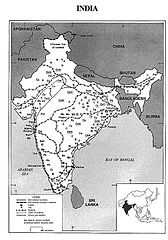
Photo by Author: United States Geological Survey
Source: http://minerals,usgs.gov/minerals/pubs/country/maps/93129.gif
The policies that minimize poverty and drastically increase the wealth generated
1. For the commencement of a business, a single license may be required which can be obtained either via the internet (if this possibility exists by the prospective entrepreneur) or through the physical presence of the candidate businessman that requests license in the municipality which will have his business its headquarters.
The procedure must not exceed three days. The cost of the license must be low regardless of the type of business. Since the state has a stable tax framework, the state’s revenues will come from the wealth generated by each company/or business activity of individual.
Such a policy of abolishing the many licenses that are being borne by a company will incentivize a large proportion of entrepreneurs, which, by cost, they choose to operate in the shadow economy, to be normally incorporated into the real-official economy by multiplying state revenues from official taxation.
2. Completely abolish the subsidy policy for small businesses. In this way small businesses will gain an incentive to produce more at the lowest possible cost.
This policy will lead most small businesses operating in the same market to seek cooperation between them through mergers in order to gain greater economies of scale and market proportions. It is only in this way that these companies will be able to enlarge (higher amount of working capital, modernization of production, increase of the workforce, etc.).
These policies applied will result in production without restrictions in the production levels by producing high quality products. Competition will force Indian companies to adjust in order to compete on an equal term with foreign imported products, drastically reducing prices on produced domestic products, while raising wage levels.
Rising wages by falling prices will drastically increase the purchasing power of citizens regardless of their income scale. Increasing purchasing power means greater demand and consumption from the huge market of India, which will increasingly absorb the domestic products produced by constantly fueling the growth rate of the economy, demanding even more labour for a continuing increasing production level.
The greater the percentage of the population that increases its purchasing power and enters dynamically into the labour market and consumption, the more the market size to which the products of domestic enterprises are targeted is increasing.
In addition, then, and only then, the domestic industries and businesses in India would be able to implement large-scale viable economic programs.
3. Drastic reduction in the size of the public sector. May the highest caste of India, Brahmans, be the backbone of the Indian state administration, but the size of the number of civil servants should shrink drastically. Competing countries do not know about caste in societies.
Governments with their respective state administrations are like big corporations. Those who work effectively in the most economical way are those that survive. Those that run their state administration with huge costs and work ineffectively sooner or later will collapse.
The larger the size of the public sector, the greater the magnitude of state corruption. The smaller the size of the public sector, which means very well-paid civil servants, the smaller the scale of corruption.
A society that is equating, that is, where the child, independently of the qualifications he possesses inherits the position of parent in the public sector, is a society that stands still and does not progress because he does not choose the best each time, losing the momentum defined by the phrase “the right-most worthy man-in the appropriate position”.
The reduction of the public sector’s size should be done through privatization of public organizations and corporations equally and through the transfer of many responsibilities of the central administration to local governments. Local governments will then have to privatize massively their services and where this is possible.
The size of the state in salaried employees should not exceed five million. Technological modernization helps the most in this case to reduce human resources.
4. The capital resources released by the federal and state budgets respectively should be channeled through the implementation of equivalent fiscal value measures in the economy through the corresponding size reduction of indirect and direct taxation.
This will mean an even greater increase in the purchasing power of citizens. In addition, much of these saving resources from the state budgets should be directed towards education, health and farming.
5. Complete abolition of trade/labour unions with the creation of a corps of public prosecutors who will only be employed by violating the laws of labour law and will have the purpose of protecting the worker from the arbitrariness of employers.
The reason for the inability to increase the employment rate is the workers’ unions, because together with the government, they hold a high level of wages-a high barrier, with the result that there is a low level of wage employment.
6. The Indian federal government and the local governments should urge labour/work-intensive industries (e.g. power plants) to start off the use of lignite through significant incentives.
This should be done through generous funding from state banks. Indian coal production is the 3rd highest in the world according to the 2008 Indian Ministry of Mines estimates.
In addition, they could use lignite to turn it into synthetic fuels (synthetic petrol and oil respectively) that would drastically reduce fuel imports, achieving even greater savings in the state budgets.
7. Implementation of a new agricultural reform, giving land for cultivation to families that do not have proprietary land. The state must not rent the land to the farmers or give it to them free of charge (or with very low rent) for some time.
Instead, the government should give it to them by making them owners of their land. Only then are they motivated to work hard. A high and long-run objective for the government should be to achieve autonomy in the issue of nutrition.
8. The highest objective of the Indian state should be that the poorest citizen can become the owner of the medium or the way he earns a living. The state will earn from the taxation of the wealth generated and from nothing else.
This means that any citizen who has a family or not will be able to borrow a low-level small loan amount from a bank with the guarantee of the state and without intermediaries who used to eat the highest percentage of the loan.
Return to the base of India’s democracy, philosophy and millennia culture, i.e. the Panchayat-Committee of five elected people from the entire local population even if they come from the lower Castes. The Panchayat, what the Alexis de Tocqueville (1805-1843) in “Ecrits et discours Politiques”, (1843) named Panchayat as the ideal model of democracy without a state.


