



During the last two (2) years all the citizens of the world and mainly the citizens both of EU (European Union) and UK (United Kingdom) are following the proceedings of a pre-announced divorce between UK and EU. The processes of this divorce are known, and its costs are shaped until both sides come to an agreement on them.
In this article, I will refer to the extent to which it is possible that this divorce should not be finally concluded by a joint decision of both sides (UK & EU) and postponed.

Photo by Author: United Kingdom NUTS (https://creativecommons.org/licenses/by-sa/4.0/)
Source: Wikimedia.org
The financial cost of divorce is a major factor that can prevent this divorce from occurring, but I would like to concentrate in some future issues. Following, the decision of the Referendum in UK, June 23th, 2016 with subject the stay or not of UK in EU, we should look:
by Thanos S. Chonthrogiannis-https://www.liberalglobe.com
What is the landscape in the UK economy after the divorce with EU?
1. Will there be a flight of large international banking institutions from the UK to the eurozone members and the EU in general?
2. Will the clearing system that exists in the euro currency for capital market products and has so far been based in London (UK) will and irrevocably move to the eurozone/EU? What final cost will this have for the UK?
3. Will the UK products sold on EU markets be subject to a percentage of tariffs and duties burdening disproportionately and making their final sales price very high, so that they are not competing with other similar goods?
This alone will create many competitiveness problems in the productive part of the UK-tax based companies, forcing most of them to install their productive and functional piece in an EU member-country. I do not think will be achieved a trade agreement between UK and EU on these issues, and like the trade agreement between the EU and Switzerland.
The why is more complicated in both economic and historical terms, since Switzerland has been for centuries the duty-free repository of ubiquitous European citizens, the Swiss market is much smaller than that of the UK, Switzerland has characterized over time with a neutrality which is acceptable to all European countries, and sooner or later Switzerland will become a member of the EU and the eurozone equally.
In addition, EU would never want to give such an enticing divorce and a correspondingly enticing commercial deal to a former member country because it would create a precedent and so anyone who would like to leave EU could go away as if it had not happened nothing (bearable and low cost).
4. In addition, it is more likely to cut off any privileges enjoyed by Switzerland and the EU in its trade agreement, adjusting the EU to a new tougher agreement with Switzerland, which would have forced the UK to follow (Trade agreement which will be the same for all and under the same conditions for all non-European Union trading partners, rather than distinct trade partner agreements).
5. Any strategy to reduce the tax on profits of UK-based companies as a counterpart policy by the UK governments to impose tariffs and duties on products from UK and sold in the Eurozone / EU markets does not mean that it will necessarily create those presuppositions and conditions to attract investment and companies from all over the world to UK, given that Ireland is a member country of eurozone/EU and has an official spoken English language.
6. If EU wishes, it will be able to use the entire Ireland as a competitive tax environment for companies that choose to move and reside in the UK.
7. In this economic, fiscal and business environment, escaping business production to the European continent will take place slowly and steadily, creating long-term major social problems in the UK society, such as rising unemployment, increased borrowing rates over long periods, financing problems of NHS (National Health System) and the pension system from the state budget and at the same time increasing the poverty rate as the cost of living is likely to increase in an environment with ever lower incomes than is currently the case.
Why referendums are not good counselors?
The referendum and, in general, any referendum is a static event that reflects the decision at a given moment – and as it was formed by most of a people at a given moment. If after a year, e.g. since the British referendum (23/06/2016) was once again a referendum on the same issue, the decision of the majority would be very different from the decision of its referendum (23/06/2016).
If the UK remained in EU and after twenty-five (25) years, they were calling for the same referendum on the same issue – perhaps it would never have been approved to make this referendum – since another generation of UK citizens would have grown up with UK to be in EU, while another older generation would have left this world.
The referendums are always advisory to the Parliament and Government of the country in which they are held. The referendums are never raised for national issues except for issues concerning local communities. The referendums are characteristics of the direct Democracy.
However, the great Greek philosopher Aristotle (384-322 BC) and later the philosopher Photinos (203-270 AC) first discovered the problems that arise from the direct democracy through the decisions the people take on all kinds of issues using referendums. It was the referendums in ancient Athens which,
1. sent to prison the great Greek philosopher Socrates (469-399 BC) who ended up drinking the hemlock,
2. gave rise to charlatans like Alcibiades who led the whole people to the failed Athenian expedition in Sicily/Syracuse (415-413 BC),
3. these constantly created turbulences in the Republic of ancient Athens through the establishment of tyrants and dictatorships alternating in ancient Athens.
If in 2010, when the Greek fiscal crisis broke out, the then Greek government (2009-2011) called for a referendum on whether Greece should implement austerity policies while entering the Memoranda to receive funding with aim to reduce its gigantic fiscal deficit to the state budget or not to apply any of the above, then the Greek people would vote no in austerity policies.
In this case, the then Greek government – if it applied the no of the referendum – should make a violent adjustment to the state budget by removing Greece from outside the eurozone and the EU.
But in this case the Greek economy would go back decades and the Greek people would live with greens and from the humanitarian aid that the other countries would send. The fortune, and perhaps the life of the then ruling ones, would be ignored, simply because the people always see the outcome and not what it decides in a referendum.
In June 2015, after a five-year delay, the then Greek government (2015-2018) provoked and made a referendum on these austerity policies and the implementation of a Memorandum of Understanding (July 2015). The result of the referendum was no in austerity policies.
The then Greek government (2015-2018), to avoid the consequences I described above, was forced by the then Prime Minister Alexis Tsipras (2015-2018) not to implement the result of the referendum by doing “kolotoumba” – after he had caused the referendum.
On their own, these events prove that the Governor and, more generally, the democratic system of government should not appeal to the people for critical decisions – through referendums – because never the whole people can have accurate, true and detailed information on critical issues. At the same time, are involved interests that affect the citizens’ judgment, without these interests being obvious.
Moreover, besides the fact that the people can easily fall victim to deception by lobsters and liars, the vote in referendums can be given by some with a slight heart, without understanding the immediate and long-term effects. Naturally, the citizens are not responsible for it.
The paradox is that England with the publication of Magna Carta (1215 its first edition), and later with the requirement and adoption of a written Constitution of the 17th-18th century (i.e. Act of Settlement (1700), Union with Scotland Acts (1706-1707, Petition of Rights 1888, Source: Wikipedia).
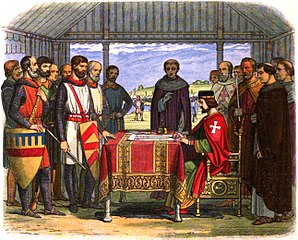
James William Edmund Doyle (1822-1892)
https://en.wikipedia.org/wiki/magna_carta
https://creativecommons.org/licenses/by-sa/3.0/
In which the distinction of powers was defined while defining as the main task of Parliament the protection of human rights against any arbitrariness under the governance of the country by the respective government, created and demonstrated in practice the proper functioning of the representative Republic (mainly due to the existence of a written constitution and by the authority that Law is Rex) changing the world’s political data to date on how best to govern a country by using the Democratic system.
In this way, England has once again drawn from the scene the existence of all the negative actions that can cause to the governance the rule of direct democracy through the referendums.
And yet England made the mistake for internal party reasons of the then ruling party to give a referendum to the people on the eve or not of the UK in the EU. But without this referendum being by nature binding but always advisory to Parliament and the Government, made it the main subject of electoral debate (about the implementation of the referendum decision).
By neglecting the fact that referendums on such crucial issues almost always divide the people for many years if the result of the referendum is fully adopted and not used as a counsel for the decisions that Parliament will take on this issue.
The geopolitical questions that want answers
Europe as a geographical area but also as a market was, is and will always be the vital space of UK. It is the feeder of the UK economy and the main destination of UK products and services.
There will surely be some who will say that UK’s primary vital space and market is the British Commonwealth and not the EU.
But those who say it will have to give any possible answers to what will happen in 20-25 years from today, perhaps much earlier, where the very likely global Chinese hegemony in terms of GDP (Gross Domestic Product), in terms of the largest state in population and as a global military force, it will try to “break” its accumulated “muscular” power into its immediate neighbors in the Pacific Ocean and not only.
In this case, to create a barrier to global Chinese hegemony, the USA (United States of America) will lead a new common monetary union with the other Anglo-Saxon Pacific countries that also belong to the British Commonwealth (Canada, Australia, New Zealand) and directly connected to this monetary union the allies of USA, like Japan, South Korea, Philippines.
Trying in this way to impose new international institutions and rules of trade, accepted by the world, in order to bind in this framework rules China with its capitalistic economy but not its liberal governance.
Another reason that the USA will seek their participation in this new common monetary union with these countries will be their attempt to halve the size of their inappropriate external debt with the possible unilateral disappearance of much of this.
When the Anglo-Saxon countries that make up the British Commonwealth are incorporated into a new monetary union with the USA, then the British Commonwealth will not exist as a single market as we know it, free of tariffs for UK products and services.
In this new monetary union with a leading power to be the USA what will be the position of the UK, and especially after the loss of the countries belonging to the British Commonwealth? Will enter in this new common monetary union the UK?
- If the answer is no,
In this case the markets in which will be addressed the services and the produced products of the UK in which will not be imposed tariffs, duties and increased fees will shrink dramatically with the analogous consequences in the economic, commercial and social life of UK.
- If the answer is yes,
How it will enter? Will it accept the removal of control of the imports which are originated as much from USA as from the other countries of that monetary union that would test its balance of payments resilience? What participation will have the UK in the decisions of this union?
The UK already belongs as full member of EU and is already in its mechanisms and decision-making centers. Which is the reason to leave from one monetary, economic, political and in future defense union and after years of being forced to enter in another new common monetary union, ignoring whether it will hold a leading position in this new common monetary union, while today can remain as full member of the EU and to lead in many of EU’s sectors given that the EU is its vital space?
Is it better, after the divorce with EU, the UK to be consider as an “enemy” country from EU and the opposite the UK to consider the EU as an “enemy” country and market and whatever this means?
With the simultaneous existence of new monetary unions in the world, which will not allow without barriers and without tariffs and duties the sale of the UK’s products and services to them?
Or
is it better to continue to participate, as full member of EU, in the EU’s mechanisms and centers of decisions equally, participating the British people in the common course and prosperity of the one and unique European nation (which is composed of all the nations of the continent, whether they live and write history in continental Europe or live as islanders of the European continent)?
Besides, all nations and countries of the European continent have been aware among them not only today but since the past millennia. Anyway, the opposites are attracted.
The common challenges that unite the EU and the UK
I believe that the challenges for both EU and UK are common and are much more than any of the differences, and only united under the same roof, can face them successfully. Some of this type of challenges are:
1. The common economic-financial, tax and fiscal policy equally in the whole territory of EU.
2. The challenges faced by both the European Union and the UK by other neighbors.
3. The creation of common institutions and structures that can provide the maximum in a very fast time to all citizens independently in which member-country of EU they live.
4. The creation of common defense structures and European defense forces.
5. Common and effective institutions to tackle immigration but also to combat repression of international and domestic terrorism.
6. A common welfare state in the EU etc.
The internal migration to the EU (that is, from member-countries of EU and eurozone to other member-countries of EU and eurozone) and any heavy burden on the UK’s budget, as any heavy burden of the state budget of every other member-country of EU, can be solve-as problem-by a specific organization within the framework of EU (more about this I will mention in another article).
The only pleasant event that can arise from a referendum like the British one of 23/06/2016, is that the negotiations between UK and EU, as to their forthcoming divorce, can illuminate and clearly illustrate the terrible costs that both sides will have at both political, economic, and social levels.
This can give the real picture and the data that can truly inform the British people about the effects of a divorce. In this case, and having all the data in their disposal, the English government could turn to the people justifying any decision not to proceed to the divorce with the EU having first informed the English Parliament and the rest of the UK Parliaments.
The Parliaments of UK (England, Scotland, Wales and North Ireland) having at their disposal all the data plus the decision of the referendum of 23/06/2016, will can, after a vote, to decide on the stay of UK in the EU.
At the same time, the leadership of EU and the leadership of UK in a simultaneous and common report will must together announce on the stay of UK in the EU and to talk for a common course of achievement of common targets and the UK to continue to be member of EU.
In addition, the exit of UK from the EU will cause a deep breach in what we call West and Western World, given that will create geopolitical rearrangements within the Western World.
Thanos Chonthrogiannis
It is forbidden by the law of intellectual property in any way unlawful use/appropriation of the present article, with severe civil and criminal sanctions for the offender

